
January 3 – March 7
Saturdays, 2:00 – 4:00 pm
Indianapolis Liberation Center
Facilitator: Derek Ford
Guest facilitator: Noah Leininger
Office hours: By appointment
Course description
Karl Marx wrote volume one of Capital, the only volume he published and republished in his lifetime, not to weigh in on academic debates but to provide a theoretical weapon for the working, oppressed, and colonized peoples to wield in our fight against the ruling class. Especially since the triumph of the Bolshevik Revolution in 1917, it’s done just that. Throughout Asia, Africa, and Latin America revolutionaries like Võ Thị Thắng, Kwame Nkrumah, Amílcar Cabral, Leila Khaled, Mao Tse-Tung, Kim Il Sung, Fidel Castro, and the millions of people they led to victory studied the book. In the U.S., revolutionaries like W.E.B. Du Bois, Claudia Jones, Assata Shakur, and Esther Cooper did the same. Of the 99 books recovered from George Jackson’s prison cell, three were volumes of Capital. This is not to say that one must read Capital to be a revolutionary nor that every fighter read the text; the point is rather that it was—and continues to be—an invaluable resource in the fight for a better world.
While the book can be overwhelming or intimidating, everyone has the capacity to read, understand, and apply it to their lives and struggles. The key is that we read it collectively, as comrades. As capitalism’s credibility rapidly declines and interest in socialism is, in the U.S., at its peak, this is the time to study the book together. We want to read it so we can better understand, apply, defend, and advance whatever struggles we’re fighting.
All are welcome to participate, regardless of your ideology, political affiliation, or familiarity with revolutionary theory. We promise you’ll get something out of it and contribute to our collective understanding, too.
Required text
You can purchase one of two different translations, the first of which is preferred (and free).
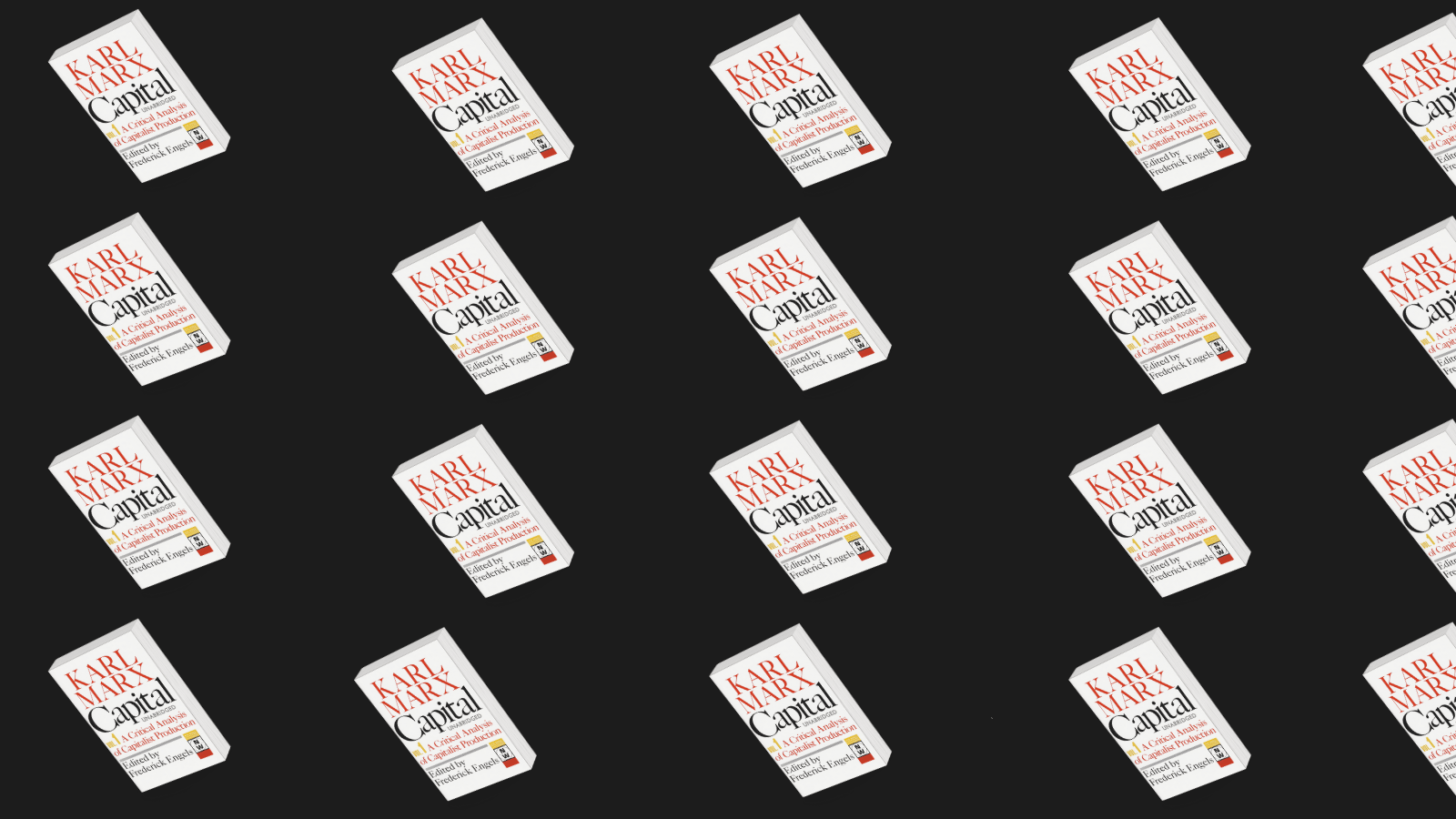
- Karl Marx, Capital (vol. 1): A critical analysis of capitalist production, trans. S. Moore and E. Aveling (New York: Internationtal Publishers, 1867/1967).
* Note: This is the recommended version of the text an the original English translation. Participants get 10 percent off if you purchase your copy from the Indy Liberation Store). It is also available online for free here. - Karl Marx, Capital: A critique of political economy (vol. one), trans. B. Fowkes (New York: Penguin and New Left Review, 1867/1990).

While you can use any complete edition of the first volume of Capital, we recommend the International Publishers edition, which is the original English translation of the book. This is the preferred edition for political and and literary reasons, which we’ll cover in class.
Participants get 5 percent off if you get your copy at the Indy Liberation Store (and it’s also the edition available for free online here). The other main version is the Penguin edition, which is perfectly fine. However, it’s easiest if we’re all on the same page (literally), although the facilitator will try to identify the key passages in both versions.
The first version is the preferred edition for political and and literary reasons, which we’ll cover in class. Participants get 10 percent off if you get your copy at the Indy Liberation Store (and it’s also the edition available for free online here). The other main version is the Penguin edition, which is perfectly fine. However, it’s easiest if we’re all on the same page (literally), although the facilitator will try to identify the key passages in both versions.
Course schedule
Session 1: Sat. Jan. 3 (prefaces and afterwords)
– Recommended reading: Becker, B. (2016). “Theory and revolution: Addressing the break in ideological continuity,” Liberation School, 28 September.
Session 2: Sat. Jan. 10 (chapters 1-3)
Session 3: Sat. Jan 17 (chapters 4-9)
Session 4: Wed. Feb 4 (chapters 10-14) – VIRTUAL
Session 5: Sat. Feb 7 (chapter 15)
Session 6: Sat. Feb. 14 (chapters 16-22)
Session 7: Sat. Feb. 21 (chapters 23-24)
Session 8: Sat. Feb. 28 (chapter 25)
Session 9: Sat. Mar. 7 (chapters 26-33)
Note: You do not need to have done all (or any) of the reading to attend.
Reading guides
There are several reading guides and companions to Capital and there is no shortage of commentaries about the book, all of which are of varying qualities, come from different political orientations and historical contexts, and so on. The perspective we’ll take in this course is that of organizers working not just to understand capitalism or Marxism, but to use that understanding to transform our world, and in particular to advance the revolutionary struggle in the U.S. As a result, we’ll be studying the book to discern Marx’s arguments and discoveries, while focusing on how they relate to the movements of our day.
The following reading guides, which were adapted from Liberation School, are meant to serve as guideposts as you make your way through the book. The danger that comes with reading guides is that we read for what the guide asks, which is another way of saying you read for what I have read in the book. We want to avoid this danger.
Session 1: No reading guide
Session 2: Chapters 1-3
Session 3: Chapters 4-9
Session 4: Chapters 10-14
Session 5: Chapter 15
Session 6: Chapters 16-22
Session 7: Chapters 23-24
Session 8: Chapter 25
Session 9: Chapters 26-33
Additional readings and resources
As with reading guides, there is a danger with companions or commentaries on Capital. If possible, try to read Marx on his own terms before delving into any other resources or literature.
Reading “Capital” with Comrades (podcast series)
This is a podcast series produced by Liberation School and is available on Spotify, Soundcloud, Apple Podcasts, and other platforms. It not only makes the first volume of Karl Marx’s Capital accessible to a new generation of activists and organizers, but reads the text from the perspective of revolutionary socialist fighters in the U.S. today.
The interactive, chapter-by-chapter class for all skill levels is taught by this study group’s facilitator, Derek Ford, hosted by Patricia Gorky, produced by Mike Prysner, mixed by Nic de la Riva, with music by Anahedron and artwork by Nathan Schmidt.
Reading Marx’s “Capital” with David Harvey (You Tube)
This is a set of 12 videos, each of which covers a class in a course David Harvey taught on volume one of Capital at The People’s Forum in 2019. of a 12-part course David Harvey delivered at The People’s Forum in 2019.
David Harvey also has his Companion to Marx’s “Capital” available for free here.
Harry Cleaver reads “Capital” Politically (books)
Harry Cleaver has two resources on volume one, both of which are available for free. First, he has a short and highlighy interesting book, Reading “Capital” Politically that mostly focuses on the first three chapters.
He recently published a longer and more accessible reading of the book titled, 33 Lessons on “Capital:” Reading Marx Politically.