
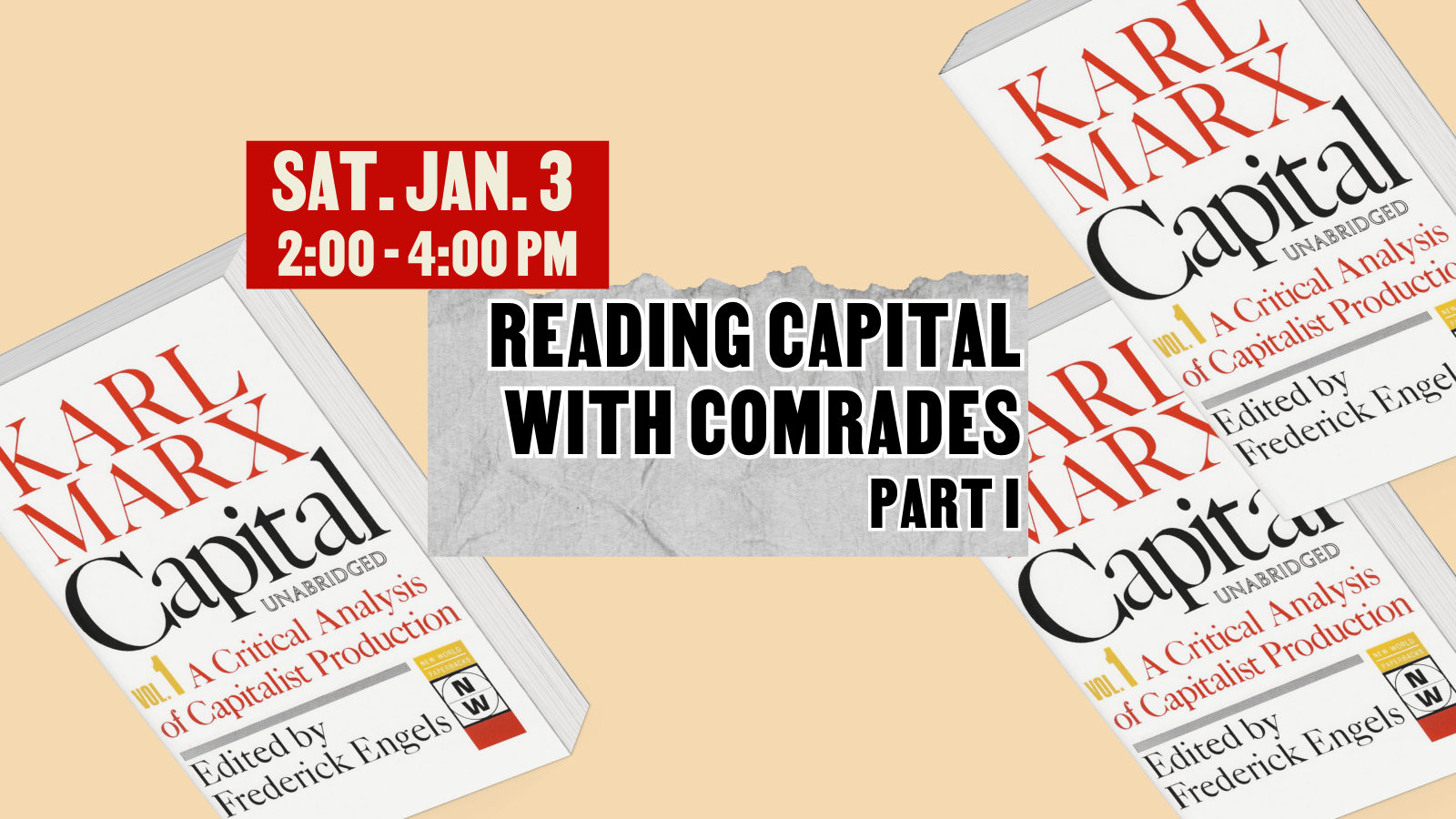
Saturday, January 3
2:00 – 4:00 pm
Indianapolis Liberation Center
Please register here if you plan on attending!
The Indy Liberation Store is thrilled to invite you to read, re-read, or listen in on our first collective study group! We’re kicking 2026 off by reading Karl Marx’s Capital with friends and comrades, making our way through the book every Saturday at the Liberation Center between January 3 and February 28. All are welcome to participate, regardless of your ideology, political affiliation, or familiarity with revolutionary theory. We promise you’ll get something out of it and are certain you’ll contribute to our collective understanding, too. Plus, we’ll provide reading guides, worksheets, and other resources to help prepare for the discussion if you’d like.
This introductory session covers the prefaces and afterwords to the book. We begin our study of Capital, vol. 1 by discussing what it means to read, study, and apply the book as comrades in the struggle for socialism in the U.S. today. We situate our reading within the struggle to not only popularize and give definition to socialism, but to establish Marxism as the guiding theory of struggles. Next, we cover some of the history and context of the book and finally examine the prefaces and afterwards by Marx and Engels, we introduce the form, content, methodology, and context of Capital, paying particular attention to Marx’s method of abstraction.
In addition to covering the readings, we’ll get to know each other, what kind of support we might need, what we hope to get out of the study, and more. For more details (including the reading schedule), see below.
Readings and resources

While you can use any complete edition of the first volume of Capital, we recommend the International Publishers edition, which is the original English translation of the book. This is the preferred edition for political and and literary reasons, which we’ll cover in class.
Participants get 5 percent off if you get your copy at the Indy Liberation Store (and it’s also the edition available for free online here). The other main version is the Penguin edition, which is perfectly fine. However, it’s easiest if we’re all on the same page (literally), although the facilitator will try to identify the key passages in both versions.
Reading: Prefaces and Afterwords
Suggested reading: Becker, B. (2016). “Theory and revolution: Addressing the break in ideological continuity.” Liberation School, 28 September.
Resource: Reading Capital with Comrades podcast, episode one
About the facilitator

Derek Ford is a teacher, educational theorist, and organizer who volunteers as the Organizational Relations Director at the Liberation Center. They’ve written eight books, including Teaching the Actuality of Revolution: Aesthetics, Unlearning, and the Sensations of Struggle (2023).
Derek is a contributing editor at the Hampton Institute, associate editor of Postdigital Science and Education, and deputy editor of the Journal for Critical Education Policy Studies.
Ford also hosted and co-created the podcast series, Reading Capital with Comrades, and recently finished co-editing Shaka A. Shakur’s book, Manifestations of Thought: When the Dragon Comes (2025).
About the book
Karl Marx wrote volume one of Capital, the only one he published and republished in his lifetime, not to weigh in on academic debates but to provide a theoretical weapon for the working, oppressed, and colonized peoples to wield in our fight against the ruling class. Especially since the triumph of the Bolshevik Revolution in 1917, it’s done just that. Throughout Asia, Africa, and Latin America revolutionaries like Võ Thị Thắng, Kwame Nkrumah, Amílcar Cabral, Leila Khaled, Mao Tse-Tung, Kim Il Sung, Fidel Castro, and the millions of people they led to victory studied the book. In the U.S., revolutionaries like W.E.B. Du Bois, Claudia Jones, Assata Shakur, and Esther Cooper did the same. Of the 99 books recovered from George Jackson’s prison cell, three were volumes of Capital. This is not to say that one must read Capital to be a revolutionary nor that every fighter read the text; the point is rather that it was—and continues to be—an invaluable resource in the fight for a better world.
While the book can be overwhelming or intimidating, everyone has the capacity to read, understand, and apply it to their lives and struggles. The key is that we read it collectively, as comrades. As capitalism’s credibility rapidly declines and interest in socialism is, in the U.S., at its peak, this is the time to study the book together. We want to read it so we can better understand, apply, defend, and advance whatever struggles we’re fighting.
Reading schedule
Session 1: Sat. Jan. 3 (prefaces and afterwords)
Session 2: Sat. Jan. 10 (chapters 1-3)
Session 3: Sat. Jan 17 (chapters 4-9)
Session 4: Sat. Jan 24 (chapters 10-14)
Session 5: Sat. Jan. 31 (chapter 15)
Session 6: Sat. Feb. 7 (chapters 16-22)
Session 7: Sat. Feb. 14 (chapters 23-24)
Session 8: Sat. Feb. 21 (chapter 25)
Session 9: Sat. Feb. 28 (chapters 26-33)