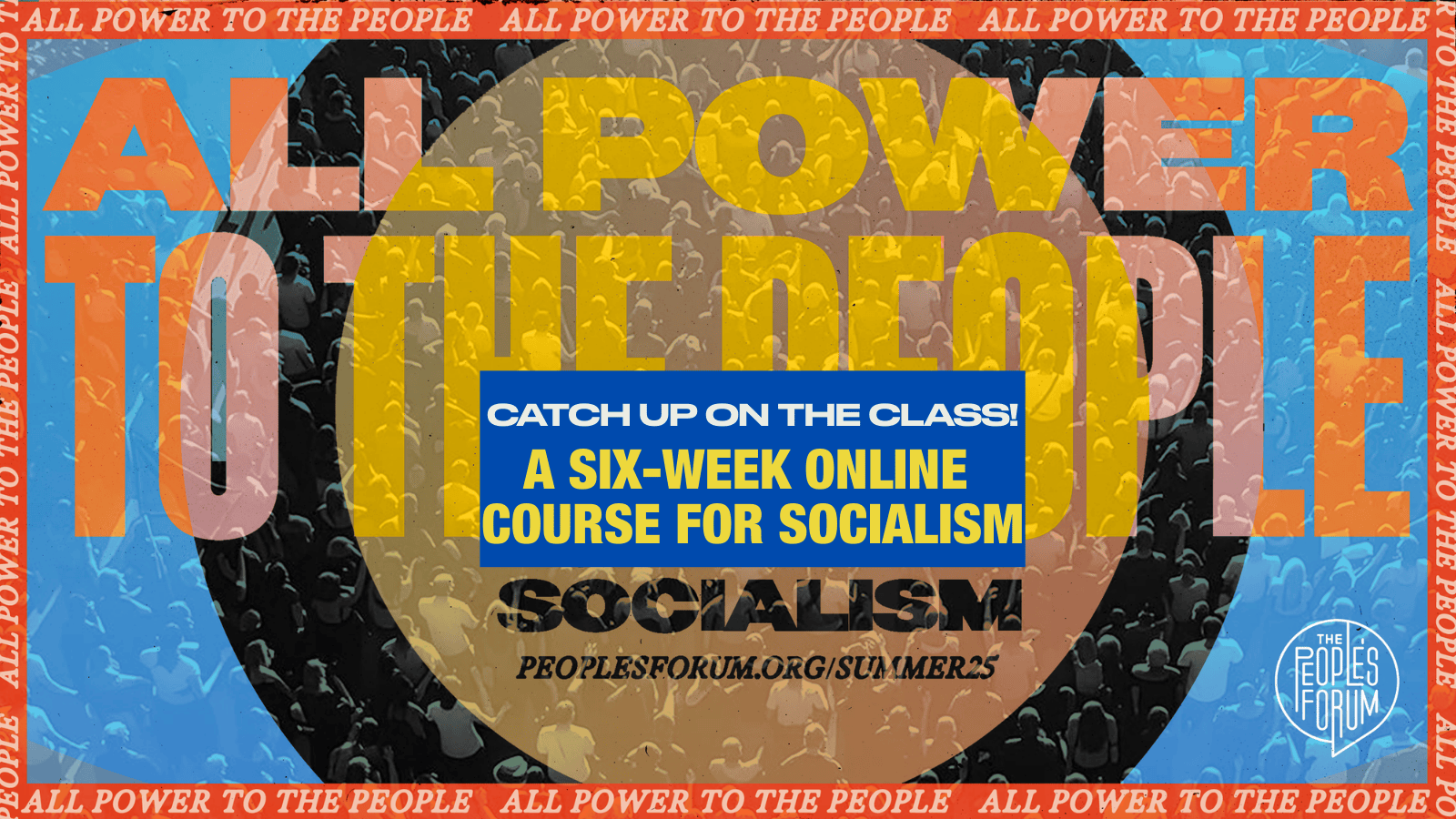
Organized by The People’s Forum, “All power to the people” was a six-week hybrid course consisting of 11 classes held during. The course brought together organizers, activists, and anyone committed to building a better future. We are happy to republish the classes as a permanent resource on our website.
A better system of organizing society is not only possible, it is necessary. And if we are organized, we can build a society that serves and prioritizes the needs of the majority, the everyday working people who make the world run. That system is socialism: a system in which the working class holds political power, and the economy is planned to meet the needs of the people and the planet.
Through a collective study and discussion of history, theory, and science, we explore socialism’s proposals and the real potential for a socialist revolution in the United States; one that could begin to lift the burden of war and oppression from the people of the world. Together, we can define a people’s vision for a society where power is in the hands of the working class, not the billionaires. That vision can become a reality, but only if we organize to build it.
Class 1: Reform… and revolution
From Trump’s billionaire’s agenda to global war and economic collapse, we are living in a system in deep crisis. This class introduces socialism not as an abstract idea, but as a necessary solution to the problems we face. We’ll define socialism in clear terms, explore what it means for the working class to hold power, and open the door to what it would look like to build a different kind of society.
Instructor: Layan Fuleihan, July 15, 2025
Class 2: How the world changes
How do systems of power rise and fall? This class introduces the Marxist method for understanding how societies change. We’ll study the forces that shape history, from the development of tools and labor to the emergence of class struggle, and learn how changes in production have transformed every society. By grounding ourselves in this method, we’ll sharpen our ability to analyze the present and organize toward a radically different future.
Instructor: Brian Becker, July 17, 2025
Class 3: The future of capitalism, AI, climate catastrophe
What future does capitalism offer us? A rapidly heating planet, unemployment on the rise, and growing inequality everywhere we look. This class explores two major crises threatening humanity’s future: environmental collapse and AI-driven economic restructuring. We’ll expose how climate disaster and the use of new technology in the exploitation of workers are not just a result of “mishandling” or natural results of new innovations, but really are inevitable outcomes of an economic system that values profit over human needs.
Instructor: Thejas Wesley, July 22, 2025
Class 4: How the people took power: Lessons from 1917
Socialist revolution is not just an abstract term, it’s happened before. This class looks to the 1917 Bolshevik Revolution to understand how ordinary working people seized power and built the world’s first socialist state. We’ll study the material conditions that made this rupture possible, the role of the Bolshevik Party, and what it meant to establish a state with workers at the helm. We’ll ask: What were the challenges and achievements of this revolution? And what can we learn from 1917 as we study what’s possible today?
Instructor: Layan Fuleihan, July 29th, 2025
Class 5: The violent origins of capitalism
“Capitalism comes into the world dripping from head to foot, from every pore, with blood and dirt.” – Karl Marx This class traces how the transatlantic slave trade, settler colonialism, and the theft of Indigenous land gave rise to the modern capitalist system. We’ll examine how forced labor, genocide, and white supremacy were tools of violence essential to the accumulation of wealth and the organization of society in the U.S. Understanding these foundations helps us see how capitalism continues to function today: through racism, extraction, and exploitation, and clarifies where our fight for the future lies.
Class 6: The unfinished revolution: Black Reconstruction
Reconstruction was one of the most revolutionary periods in U.S. history. After the Civil War, newly freed Black communities organized to transform society: building schools, seizing political power, redistributing land, and redefining what freedom really means. This class explores Reconstruction as a working-class experiment in democracy and socialism, and asks why it was so violently overthrown by the white ruling class. By returning to this “unfinished revolution,” we uncover lessons about power, repression, and the ongoing fight for a “third reconstruction” today.
Instructors: Eugene Puryear and Amari Butler, August 5th, 2025
Class 7: The Civil Rights Revolution: The Second Reconstruction
The Civil Rights revolution shook the foundations of U.S. capitalism and imperialism. This class examines how Black organizers advanced revolutionary demands, built mass organizations, and linked domestic liberation with international struggles. We’ll look at what these movements achieved, how the state responded, and what they teach us about the challenges of building power in the heart of the empire.
Instructors: Amari Butler and Eugene Puryear, August 7, 2025
Class 8: The case for socialist reconstruction
Class 9: Can workers run our society?
Capitalists claim they’re the only ones who can manage a complex economy, that the workers don’t have the “hard skills” or the “work ethic”. But is that true? This class breaks down how a socialist economy could be run by workers, communities, and public institutions. What would happen to giant corporations like Amazon or UPS? How would production be organized? Through concrete examples and practical proposals, we’ll discuss how the working class can run society, doing it better than the billionaires could even imagine.
Class 10: Socialism: A system by the people, for the people
Over the past 6 weeks, we have explored socialism’s vision and proposals for the future and the real possibilities for revolutionary change in the U.S. Now, we ask: what comes next? This final session is a collective call to action – how will we take the lessons from this course and put them into action? We will reflect on key lessons from the course and history and map out concrete next steps for building socialist and working-class consciousness, power and organization in our communities.
Panelists: Eugene Puryear, Layan Fuleihan, Brian Becker, and Salvatore Engel-Di Mauro, August 19th, 2025
Class 11: Building socialism: Our next steps
Over the past 6 weeks, we have explored socialism’s vision and proposals for the future and the real possibilities for revolutionary change in the U.S. Now, we ask: what comes next? This final session is a collective call to action – how will we take the lessons from this course and put them into action? We will reflect on key lessons from the course and history and map out concrete next steps for building socialist and working-class consciousness, power and organization in our communities.
Instructor: Manolo De Los Santos, August 21st, 2025