
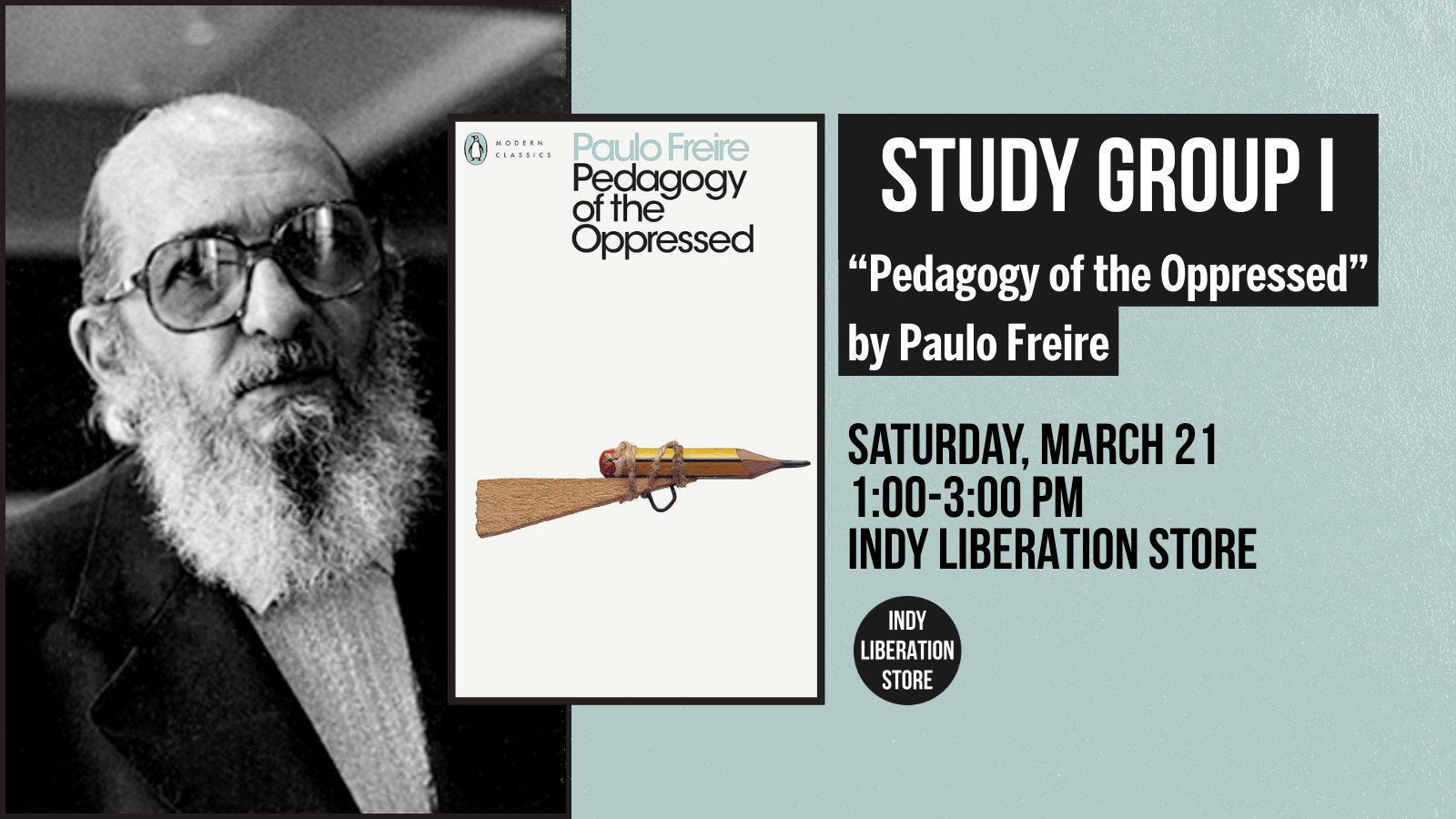
Saturday, March 21
1:00 pm
Indy Liberation Store
1619 Prospect Street
Facilitator: Noah Leininger
Course Description:
As the capitalist government wages war on education, stripping funding from schools and eliminating the right of voters in Indianapolis to elect a school board with control over its buildings and transportation, the lessons from Paulo Freire’s Pedagogy of the Oppressed are more relevant and urgent than ever. Written as a result of his work with illiterate workers across the Global South, for which he was imprisoned, Pedagogy of the Oppressed has become a must-read text for educators, organizers, and revolutionaries of all types.
“There is no such thing as a neutral educational process,” writes Richard Shaull. Freire illuminates the contrast between domineering and dehumanizing concepts and approaches to education and those practices that restore humanity and empower the oppressed in their task to transform the world, including the oppressed and their oppressors into new people in new relationships with one another.
All are welcome to participate, regardless of your ideology, political affiliation, or familiarity with revolutionary theory. We promise you’ll get something out of it and contribute to our collective understanding, too.
Required Text:
Paulo Freire, Pedagogy of the Oppressed, trans. Myra Bergman Ramos (New York: Continuum, 1970). Purchase at the Indy Liberation Store here.
Course Schedule:
Session 1: Saturday, March 21 (Paulo Freire’s centennial: Political pedagogy for revolutionary organizations)
Session 2: Saturday, March 28 (preface through chapter 2)
Session 3: Saturday, April 4 (chapter 3)
Session 4: Saturday, April 11 (chapter 4)
Note: You do not need to have done all (or any) of the reading to attend.
Reading Guide:
The reading guide available at Liberation School is meant to serve as guideposts as you make your way through the book. The danger that comes with reading guides is that we read for what the guide asks, which is another way of saying “you read for what I have read in the book.” We want to avoid this danger.