
The current Indianapolis Public Library CEO Greg Hill has given his patrons and the city yet another reason to be disgusted by and ashamed of the Board’s botched handling of the CEO search.
The existing reasons?
Hill never applied for the job. Hill never interviewed for the job. Hill never stated publicly he wanted the job. He was not a finalist in a nationwide search for a new CEO. There were two finalists in a prior nationwide search: Gabriel Morley and Nichelle M. Hayes. Astoundingly, the Board–with two dissenting votes–decided to offer Morley the position. Morley, who was at least smart enough to know he wasn’t wanted in our city, immediately declined the position. Instead of offering the position to Hayes, as is customary, the Board doled out a series of excuses and contradictory lies over the next few months.
Finally, surrounded by police officers to keep members of the public at bay, they anointed Greg Hill as CEO behind closed doors.
Then after his short time of lackluster service and a botched repair at the Central Library–which was closed for several months–he and the Board decided Hill needed a $60,000 raise. The community had other thoughts. Yet as is customary now, the Board completely disregarded the will of those they serve and, on June 22, voted to increase Hill’s salary to $265,000 next year.
Now, library workers are coming forward to speak about how Hill and other executive staff and human resource administrators are facilitating a culture of sexual harassment and sexism in our library system–one that has gotten so bad that several workers have quit.
How HR and CEO Greg Hill let sexual harassment escalate to retaliation
Stephen Lane recently spoke with a former woman library worker who quit the IndyPL system after numerous complaints about her former Branch manager Michael Jenkins were dismissed and covered up. “We had multiple instances of sexual harassment by a manager and a number of staff reported this to executive leadership, specifically HR,” she told Lane on Naptown Peoples Radio. The worker, who wished to remain anonymous given the sensitive nature of the issue, said there was no follow up and that several employees had to press HR for answers and any form of response.
HR informed them they conducted an investigation and the cases were closed. However, nothing changed at Pike branch. The sexual harassment continued and it got worse: those who filed complaints faced retaliation by their immediate boss. Instead of backing down, more complaints were filed, some of which addressed the retaliation workers faced.
“We eventually pressed to meet with other members of executive leadership, myself and some other members of the location,” she said. “And we eventually met with Greg Hill, the CEO, and the head of HR, where we re-presented statements, multi-page statements, of all the behaviors that had been occurring that were against policy.” HR engaged in acrobatics when they were called out for lying. They stated they met with one of the complainants when they never did. When she stated that fact, they switched their story: HR representatives retracted their previous lie and admitted no meeting occurred because they needed to protect Jenkins “privacy.”
Perhaps the most egregious thing is that HR and Hill considered the matter “resolved” because Jenkins abruptly quit and moved across the country. As she recalls, “they said, ‘well, you know, this staff member isn’t in the building anymore, so everything is concluded.”

Michael Jenkins (left) with Greg Hill (right). Credit: IndyPL
Jenkins departure is more extreme than the usual way our library “leaders” deal with abusive managers. The one tangible tactic leadership has implemented in other cases is the temporary transfer of “problematic managers or managers or supervisors that have exhibited concerning behaviors is to temporarily move them to another location for a month for what they call ‘coaching.’” However, during this temporary period there is no coaching nor any guidance at all. This, she insists, not only perpetuates the toxic workplace environment but also does “a great disservice” to abusive higher-ups who clearly need assistance.
What ever happened to the “360 review?”
After the Board betrayed the wishes of the local community and their patrons by refusing to appoint Hayes, making up lies to excuse their ongoing refusal, and then undemocratically appointing Hill after stating they would do another national search, they eventually tried to placate workers by engaging in a 360 Review. The “360” means that the CEO’s entire work network would participate in the assessment, from Board members to branch managers and archivists to research librarians.
TJ McGovern of McGovern Consulting Group took up most of the agenda at the Sept. 19, 2023 meeting of the Diversity, Policy, and Human Resources Committee. He was there to present and deliver materials on a 360 Review as a way of assessing CEO performance. Because Hill’s tenure as CEO was so short, Dr. Patricia Payne asked Ray Biederman, chair of the committee, when the assessment would occur. According to the notes, “Chairman Biederman stated that there will initially be an effort to get a baseline by the end of… 2023. Then the following year, the first real assessment will be completed with the help of the data from that baseline.”
The CEO review process was the first item on the Committee’s agenda for their next meeting on Oct. 17. Chairman Biederman noted they were moving forward with McGovern Consulting Group. He “passed around a performance review policy and evaluation for the Board to review and so that they may develop questions for the CEO review.”
However, they never brought any resolution to the entire Board about the 360 review process. In other words, after promising the 360 review of Hill’s work in 2023 (to be completed at the end of 2024), they took no action. Had they conducted a 360 review, it is likely that most library workers and patrons could have predicted a negative result. Had any objective assessment of Hill taken place over the last three years, it would have been difficult to justify his $60,000 pay raise. Of course, the pay raise was difficult to justify even in the review’s absence and rested solely on a few comments made by Board members about his service rather than any objective data (or, again, community or worker input).
The community needs answers and accountability
As Michael Torres, a library worker and president of their union, AFSCME Local 3395, told the Indianapolis Liberator, the union doesn’t just fight for economic necessities. “It’s about a work environment,” he told Lane, “and I am glad that they are including me and that I am involved in these conversations.”
Hill needs to answer for this particular string of incidents and take responsibility and accountability for the toxic work environment he lets foster beneath him while those doing the real work fight to keep their wages consistent with inflation so he can enjoy his raise, which is more than many longtime librarians make in an entire year.
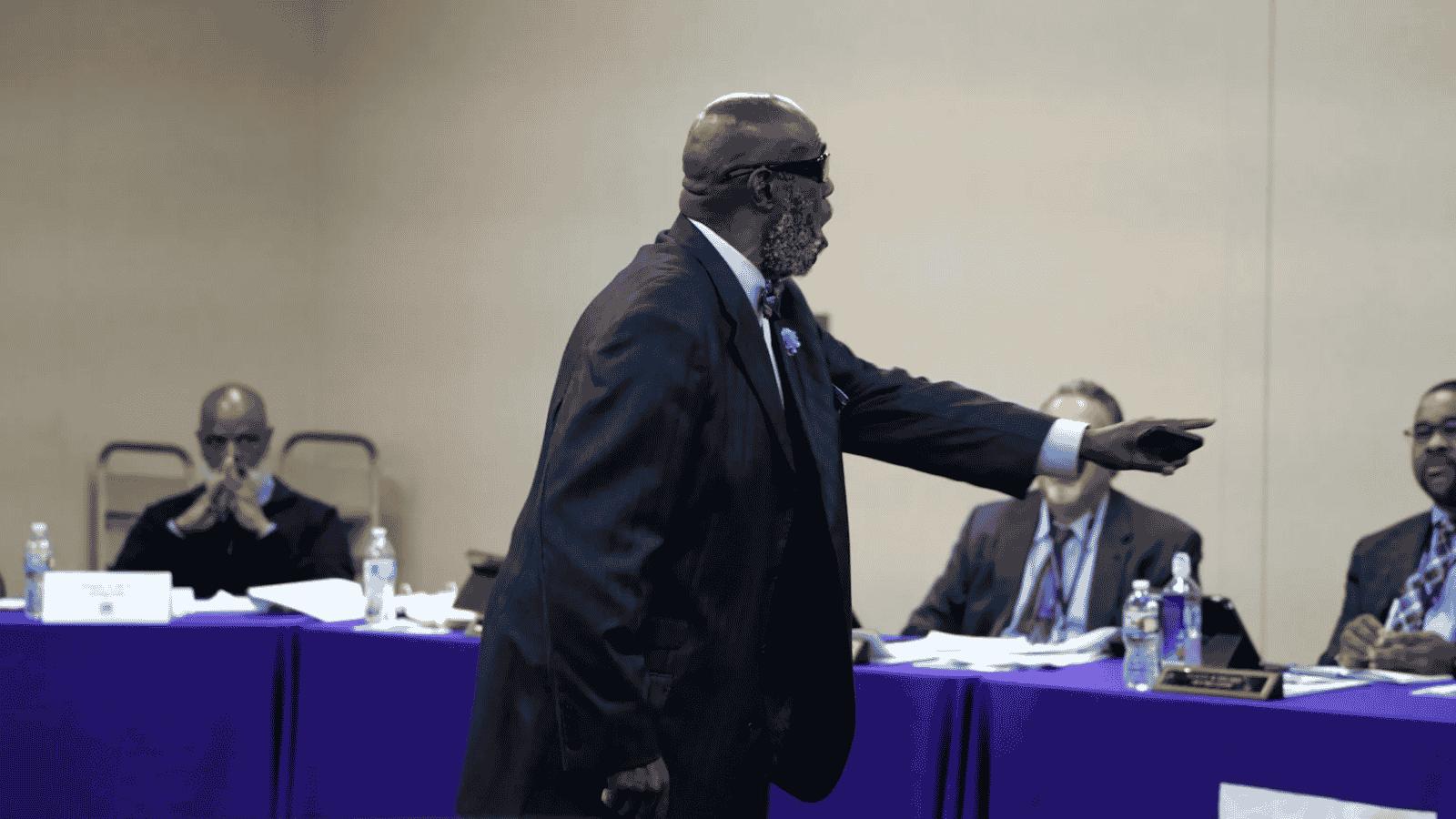
Featured photo: Elder Lionel T. Rush confronts the IndyPL Board of Trustees at a December 2022 meeting as Greg Hill (far left) folds his hands. Credit: Bryce Gustafson.