

Editorial introduction
After the Indianapolis big-screen debut of “Across Enemy Lines: Shaka A. Shakur,” the Indiana Committee of the Shaka Shakur Freedom Campaign and the Indy Liberation Center were honored to host a special panel featuring:
- Nino Brown (Jericho Chicago and Party for Socialism and Liberation);
- Stephen Lane (Indiana Black Librarians Network);
- Rev. Davanta R. Scruggs (Justice for Dalys Jett Spokesperson and Organizer);
- Derek Ford (Shaka Shakur Freedom Campaign);
- Daissy Cook (Indy Hope Packages); and
- Leon Benson (Solitary Justice Project).
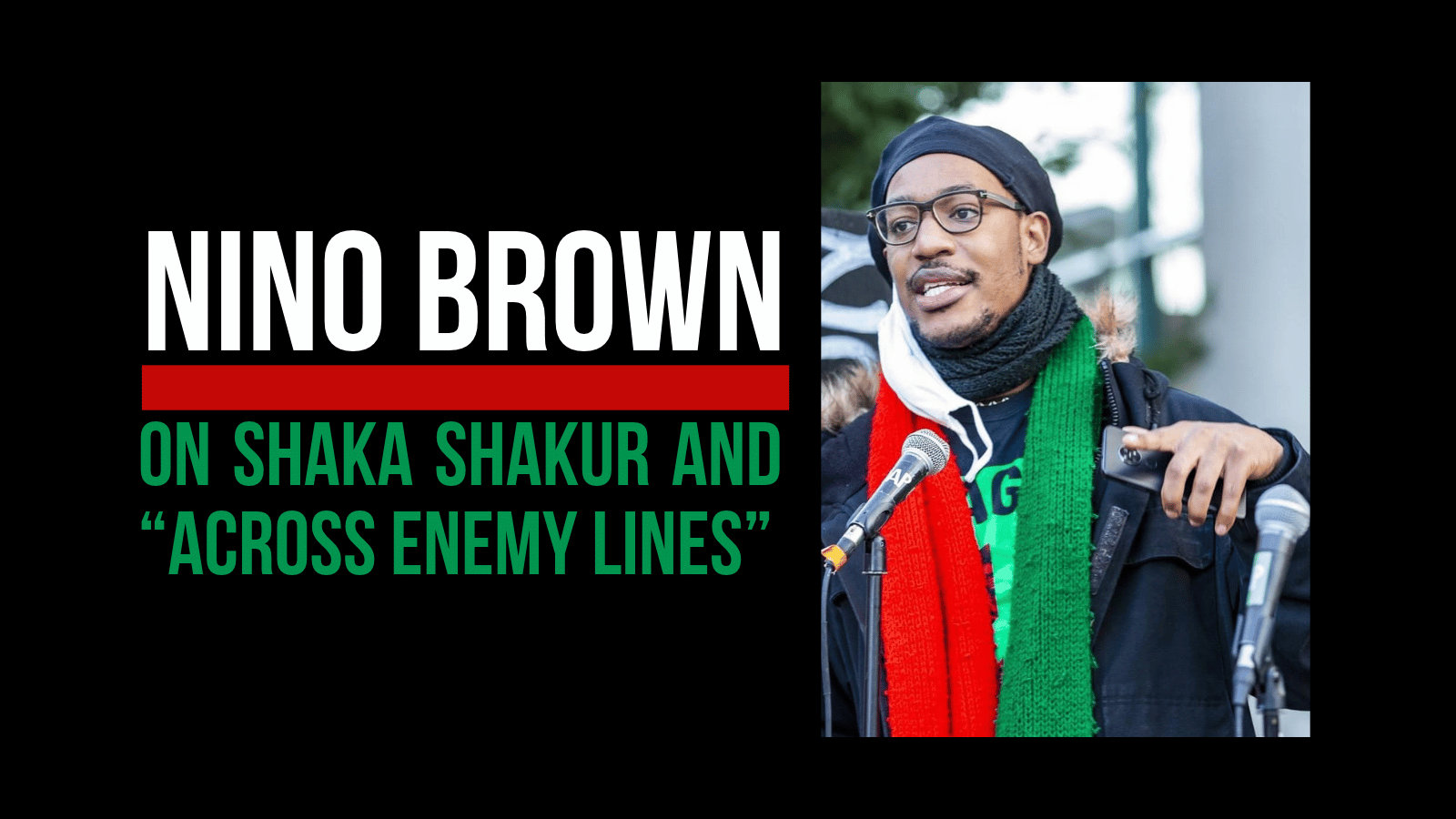
Below is a lightly-edited transcript of Nino’s speech, followed by a video of his presentation. Nino used the opportunity to pose several questions and suggest possible answers to pressing and timely questions facing the movement and everyone in the struggle, all of which can be summed up in his first provocation: “What does Shaka A. Shakur’s life and struggle demand of us?”
“What does Shaka A. Shakur’s life and struggle demand of us?”
Free the land! My name is Nino Brown. I’m a New Afrikan, member of the Party for Socialism and Liberation, and a member of the Jericho Movement. Tonight, I want to talk about a brother who has spent most of his adult life behind enemy lines and never once stopped organizing: Shaka Adiyia Shakur. I’m not here to talk about Shaka as a symbol or a face on a t-shirt. Shaka is alive. He is writing. He is organizing. And he’s still held captive by the state in exile.
Our job tonight is to not just admire him, but to ask: “What his life and struggle demands of us.”
As we all know, Shaka is a brother from Gary, Indiana, a steel town built by black labor and, you know, then abandoned by capital. He spent, he was first locked up at 16 and found New Afrikan revolutionary politics in the prisons and met elders like Zolo Azania, James Yaki Sales, and others at the Indiana State Prison where guards beat and terrorized Black prisoners. It was Shaka who organized resistance there. The state, of course, answered by shipping him and five others-the Indiana 6-to the Westville Supermax Prison, but that didn’t stop him. There, he linked prisoners’ struggles with outside groups like the Committee to End the Marion Lockdown and other human rights organizations. That pressure produced “Cold Storage: Super-Maximum Security Confinement in Indiana,” a report by Human Rights Watch that exposed what Supermax confinement really is.
When he came home, the Gary police they still didn’t let up. Since 2002, he’s been held on what we know are trumped-up charges of attempted murder and in 2018 Indiana sent him to Virginia to serve Indiana time in another state. So, the Campaign calls it what it is: Domestic exile, an attempt to cut him off from his family, his comrades, his base. And it’s failing! This documentary, this occasion that we’re discussing this book, Manifestations of Thought: When the Dragon Comes, his selected writings, are testament to that. For years before that, Shaka wrote for the Spear and Shield Collective and for anyone who would carry out his words.
So, the idea of his that I want you to hold on tonight is this. Politicized prisoners are political prisoners. We usually think of political prisoners as someone who was in the movement and then got captured. And Shaka says, “Look again. Think again. The prison itself is a political institution. It manages people inside capitalism uh that it has no use for.” When someone inside wakes up, studies, and organizes, the state targets them for that. Their captivity becomes political and whatever brought them in as well. So that matters for the Jericho movement, and it matters for all of us. It means Shaka is sitting in a cell right now reading. And here’s the contradiction that I don’t want us to move past: Shaka’s book was on the shelves in Korea University in Tokyo before he was able to have a copy himself. He didn’t get it until March of this year. So, they can lock that brother down, but they can’t lock down his ideas.
The documentary, “Across Enemy Lines: Shaka A. Shakur,” took a year. It took a year to put that together, and more. An early screening in Oakland occurred in August 2025, hosted by MXGM, Malcolm X Grassroots Movement, Community Liberation Programs, and the Haiti Action Committee, with Emory Douglas’s “Arts All over the Walls” exhibit. And it also premiered at the People’s Forum in New York City. And last December, it launched worldwide with screenings at the same time in Richmond, Indianapolis, Athens, Hanoi…
So, I want you to think about that title, right? “Across Enemy Lines.” It refuses to succumb to the language of punishment and it names the prison as a front in the war and Shaka as a combatant and not just a case number. And that’s not an exaggeration, right? Because that’s how this the state sees him as just a case number.
Now, the film carries forward the same kind of traditions as his book. The man at the center of it will likely not see the outside of prison unless we free him. And prisoners, incarcerated workers are a part of the class struggle. We know as revolutionaries that the 13th amendment did not abolish slavery. It abolished slavery except as punishment for a crime, and that exception is the hinge of the entire system. Incarcerated people, they cook, they clean, they fight wildfires, they make furniture, license plates for pennies an hour or for nothing at all. They are workers, period. They are the least free section of our class, and they are disproportionately New Afrikans, Black people, and because the prison inherited the plantation’s job of controlling Black labor, we see that abound.
Just look at Gary. Look at the south and west side of Chicago. When the mills and factories left, capital didn’t need those workers anymore. Marx called that a surplus population problem (for capital). And the United States’ answer was to police and cage us. Now, mass incarceration is how the system warehouses our people that it wants to throw away. It’s why the prison struggle is the class struggle. From Attica in 1971 to George Jackson to national prison strikes in 2016 and 18, incarcerated workers have used the same weapon that every worker has, withholding their labor. And the prison has always been a school. We’ve seen Malcolm, George, and Shaka emerge from it. So, prisoner solidarity is not charity work. Jericho, when we all fight for political prisoners, when we write letters, pack courts, fund legal defense funds, we’re connecting the most repressed part of the working class to the rest of it. A movement that forgets its prisoners has already accepted defeat.
As a revolutionary, as a Marxist-Leninist, when I think about the national question, we start from a clear position that Black people in this country are not just a racial minority. We are an oppressed nation forged through slavery, white supremacy, particularly sharecropping and Jim Crow in the Black Belt South with a common history, territory, economy, and culture. And the Communist International, which was informed by Black theorists, you know, was settled in 1928 and 1930 and Harry Haywood helped to lead that theoretical fight. Also, the foundation of the Republic of New Afrika in 1968 carried that concept and strategy forward: that the right of the New Afrikan nation of Black people to self-determination, up to and including independence, is our right and national and class oppression are welded here together. We know that Black workers are the most exploited workers of the working class. So national liberation is not a detour from socialist revolution; it’s one of the engines.
So, where does our movement stand today, in 2026? We saw the 2020 rebellions and the millions in the streets, and a lot of that energy has been dissipated, absorbed into foundations, nonprofits, the Democrats, and we have more Black faces in high places-mayors, chiefs, chiefs, executives-while our neighborhoods continue to lose housing, schools, and populations. And meanwhile, repression has also sharpened. Organizers have been hit with conspiracy and racketeering charges like the Uhuru Movement. The prosecution of Stop Cop City, the RICO case in Georgia. Our elders from the Black Liberation Army and Panther era are dying inside like Mumia Abu Jamal, but there are also still signs of life, right?
This Campaign, the Shaka [Shakur Freedom] Campaign, is tabling at HBCUs, screening films across continents, building the New Afrikan freedom Campaign, and the consciousness is there but what’s missing is an organization strong enough to hold it. So, the questions that we still have to answer, and I don’t want to, you know, stand and pretend that I have it all figured out but these are questions that I think our movement has to wrestle with together and honestly, and I think Shaka’s writings and text really give an emphasis on that.
- The first: land. The Black Belt Thesis was written about the nation rooted in the rural south and today most of us live in cities from Chicago to Atlanta and displacement is pushing us back to the south. So, what does the land question mean now.
- The second: self-determination in practice, independence, regional autonomy, or full equality inside a multinational socialist state. The nation has you know the right to choose but what institutions do we build so that the people can actually make that choice in the interim?
- Third: the black political class. How do we build a black political united front that confronts the elected officials and executives who manage our oppression without cutting ourselves off from the communities that still vote for them?
- Four: incarcerated labor. How do we organize people as workers on the inside with demands, strikes, and unions when the constitution itself says that they can be held as slaves?
- Five: what counts as political? How do we fight for political prisoners like Shaka to be recognized without weakening the case for those captured for their movement work?
- Six: the party and nation. I see it as: “How does a multinational revolutionary party earn the trust and give real leadership while supporting independent New Afrikan politic and organization?”
So, you know, Shaka’s life answers one question for us already, and that answer is that the struggle doesn’t stop at the prison wall. He organized at 16. He organized in the Supermax. He organized in exile. Whatever the barrier, he keeps moving straight ahead. So, here’s what I’m asking of all of us tonight:
- To sign the declaration and the petition to free Shaka;
- Write him letters. Break the isolation that the state is counting on;
- Host a screening of “Across Enemy Lines” wherever you are at;
- Give what you can to his Legal Defense Fund; and
- Read Manifestations of Thought and bring it to your study group.
The fight for Shaka’s freedom is the fight for our freedom as well. So free Shaka Shakur, free all political prisoners and free the land by any means necessary.
Nino Brown
11 November 2026
The Living Room Theaters
Indianapolis, IN
Watch and Share Nino Brown’s Speech!
Featuried image: A photo of Nino Brown speaking at a rally. Courtesy of: Nino Brown.