

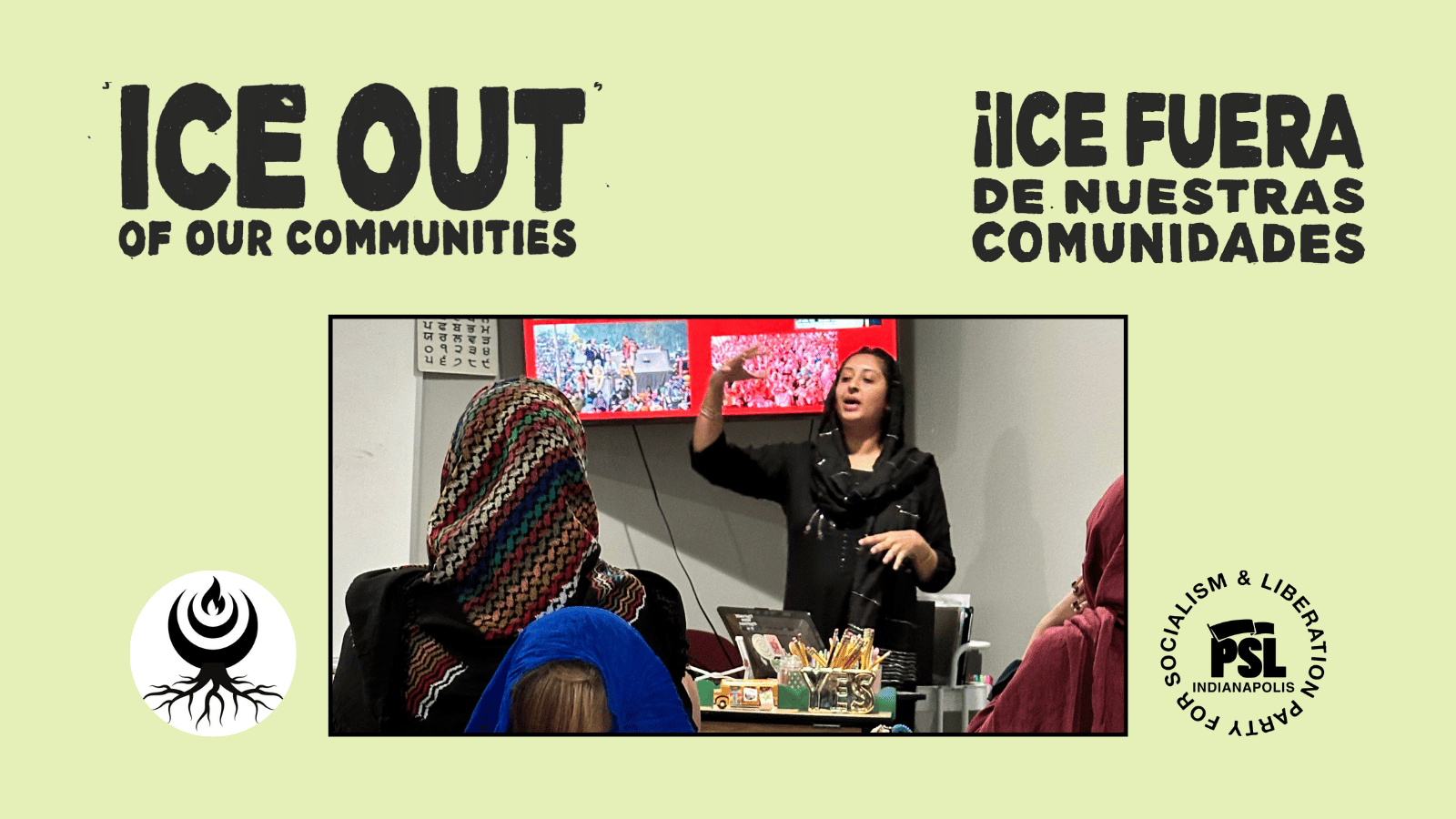
Editor’s note: The following speech was delivered at the Sept. 1 emergency rally against ICE’s re-invasion of our city. We thank Komal Kaur for permission to repost it and encourage all of our followers to support Umeed-Hope!
Hello, everyone.
My name is Komal Kaur. I’m the founder and mental health hub director of Umeed-Hope. I’m also a current School Board Candidate in Franklin Township. I’m here today coming from the mutual aid work that I’ve been doing in our community. But I’m also here as a Sikh Punjabi woman, a first-generation immigrant, a social worker and therapist.
And ultimately, as a human being. And I want to start there with our humanity. Because we talk about borders as if they are natural. As if they have always existed. As if they are unquestionable truths. But borders are invisible lines created by people.
And historically, those lines have been drawn and redrawn by people who benefit from deciding who belongs, who doesn’t, who gets to move, who doesn’t, who gets resources, and who gets exploited. And this isn’t new.
This country was built through the displacement of Indigenous people from their land and the extraction of their resources. It was built through slavery.
It was built through the exploitation of Black people whose labor created wealth while their humanity was systematically denied. And when slavery was abolished, the systems of control did not simply disappear.
They changed form. We saw criminalization and incarceration. We saw the school-to-prison pipeline. The criminalization of poverty. We saw communities devastated by drugs and addiction while those same communities were criminalized rather than adequately supported. We saw people die in jails and prisons without the accountability their families deserved. And we have seen this pattern repeatedly throughout American history:
Take the land. Take the labor. Take the resources. Criminalize the people. Then tell them that the consequences of that system are somehow their individual failure.
And that is what I mean when I talk about systemic oppression. Because systems don’t just affect one generation. They permeate families, neighborhoods, schools, housing, employment, health, mental health, and wealth. They permeate what opportunities a child is born into.
And then generations later, we look at the outcome and ask: “Why don’t these communities just work harder?”
But we refuse to ask the more important question: What happened to them before they ever got here?
What resources were taken? What opportunities were denied? What communities were intentionally neglected? What policies created the conditions we’re now blaming individuals for? And this is why I need us to understand that every single one of these issues is connected.
Surveillance is connected to immigration enforcement. Housing, education, policing, labor, and foreign policy are connected to immigration enforcement.
We are seeing ICE have access to data from Flock systems. They have access to information collected through networks that many probably thought were simply local policing tools. And that matters. Because a camera on a street corner isn’t just a camera when its data can become part of a larger enforcement system. And when we talk about who gets to live where, who can buy land, who has access to housing, which neighborhoods receive resources, and which communities are treated as suspicious. We are talking about power.
When our public schools are attacked, especially schools serving the populations being targeted by these policies, that is not disconnected either. It is part of the same ecosystem. And when we hear people publicly entertaining segregationist ideas in this very legislative cycle, we should not pretend those conversations exist in a vacuum.
Because if you can control where people live, what resources they have, what schools their children attend, surveil their neighborhoods, criminalize their existence, and then separate families through detention… you are not looking at six separate problems. You are looking at one system. And that system doesn’t stop at the border.
ICE has a global footprint. The US has been negotiating agreements with countries around the world to accept people deported from the US who are not citizens of those countries. These are called third-country removals. People can be sent to countries they have never lived in, where they may have no family, no community, no language connection, and no meaningful support. Think about what that means.
A person can be detained by the US. They can be put on a plane. They can be transported thousands of miles away. And they can be deposited in a country that is not their home. They didn’t choose that country. They may have never been there. And yet governments can negotiate their lives as if they are pieces in a puzzle.
That is why this isn’t only an immigration issue. It is a human rights issue. It is a foreign policy issue. It is a question of what happens when the world’s most powerful governments decide they have the authority to move human beings wherever they want. And we also need to talk about what is happening inside detention.
Because ICE detention isn’t simply paperwork. People are dying. And now we are also seeing changes in how those deaths are publicly reported. So, when we talk about accountability, we have to ask:
Who gets to define the numbers? Who gets to define what counts? Who gets to tell the public what happened? And what happens to the people whose deaths don’t make it into the statistics? Because those aren’t numbers. Those are human beings, parents, children, siblings, friends. Those are communities.
And even the death count doesn’t capture the full human cost. It doesn’t capture the children whose parents disappear in removal first states like Indiana. The families who lose housing because the person paying the rent was detained. The person who stops going to work because they’re afraid. The person who stops seeking medical care because they are afraid of interacting with government systems.
The psychological consequences. And as a social worker and therapist, this is something I cannot ignore.
Detention does not begin when somebody walks through the doors of a detention facility. The trauma begins long before that. It begins when a parent tells their child not to answer the door. When a child goes to school wondering whether their parent will still be home when they get back. When someone is afraid to call the police and report abuse. When people start organizing their entire lives around the possibility that someone they love could disappear.
Our bodies and brains learn fear. Our families reorganize themselves around fear. And then we’re surprised when people experience anxiety, depression, trauma, hypervigilance, difficulty trusting institutions, difficulty sleeping, difficulty concentrating.
These aren’t individual failures. These are human responses to systems that repeatedly tell people they are unsafe. And this is why I cannot stand here quietly. Because silence is also a choice.
There is a teaching attributed to Sant Jarnail Singh Bhindranwale that says essentially, that physical death is not what he feared; what he feared was the death of his conscience. Those words have stayed with me. Because as Sikhs, we come from a tradition that asks us not just to believe in justice, but to practice it. To protect those who are vulnerable. To stand up when it would be easier to sit down. To speak when it would be safer to remain silent. And for many Sikhs, that history is not abstract. We carry the memory of 1984. We carry the memory of a genocide that was followed by decades of denial, silence, and a lack of accountability. And when you carry that history, you recognize what happens when governments are allowed to decide that certain people’s lives matter less.
You recognize what happens when institutions protect themselves before they protect people. You recognize what happens when the world watches and decides that someone else’s suffering is not its problem. So, when I look at what is happening today, I refuse to tell myself that this is somebody else’s problem. It isn’t.
Because this is not just about immigration. This is about what kind of society we are willing to become. Are we going to be a society where human beings are reduced to paperwork? Where a person’s worth is determined by their documentation? Where families can be separated and we are expected to look away? Where institutions can cause harm and then hide behind bureaucracy? Where governments can move people across continents and expect us to simply accept it?
Or are we going to be a society that says: No. You are a human being before you are a category. Before you are a case number, a worker, an immigrant, undocumented. You are a human being. And your life has value.
Be still and reflect with me.
What are we doing? And I’m going to be direct with those of us who have privilege within these systems. If you are white. If you are Christian. If you have citizenship security. If you have economic privilege. If you have social power that other people in this room don’t have. I’m not asking you to feel guilty for existing. I’m asking you to put some of that privilege on the line. Use it. Call someone out. Challenge your family, your friends, your coworkers. Have the uncomfortable conversation. Because if we’re not even willing to confront the people closest to us, face-to-face, when it is uncomfortable, then we have to ask ourselves why we’re doing this work.
Are we here because this is the cause of the moment? Because we’re feeling guilty? Because we want to feel like we’re on the right side of history? Or are we here because we’re looking at these institutions and saying: fuck this. This is horrific. This is unacceptable. Human beings are not disposable. And I am willing to push back.
Those are two very different things. One can become performative. The other requires commitment. Commitment means being willing to learn. It means being willing to make mistakes and correct yourself. It means listening to people most impacted instead of assuming you know what they need. It means taking your cues from people who have been fighting these battles long before they became popular.
Because none of us knows everything. We’re all learning. But the people most impacted by these systems have been telling us what is happening for a very long time. Our job is to listen. And then to act. That is what solidarity looks like. And that is what mutual aid means to me. Mutual aid reminds us that power does not only live in government buildings.
Power lives here. It lives in the people who bring food. In the people who open their homes, who translate, who drive someone to an appointment, who organize, who make phone calls. In the people who show up and refuse to let someone suffer alone. That is power.
And I believe we need to stop hoarding power at the top and start returning power to the people who are actually on the ground doing the work. The people who know their neighbors, who know what their communities need, and who are willing to show up.
My clear call to action is that we cannot just ask for better messaging. We cannot just ask for nicer detention centers. We cannot just ask for better oversight of a system that is fundamentally built around detention, surveillance, deportation, and separation.
I am calling for the abolition of ICE. And I am calling for accountability at the highest level. Because when an administration repeatedly violates the boundaries of executive power, attacks democratic institutions, expands surveillance and detention, and uses the machinery of government to target vulnerable communities, we cannot respond with complacency. Accountability has to mean something.
And I want us to be honest about something. Follow the money. Because this is not only about ideology and political party affiliation. It is also about power. Private prison companies have been benefiting financially from the expansion of immigration detention and enforcement. That is not an accident. When human beings become a source of revenue, there is a financial incentive to keep the system growing. The mindset that enabled slavery and continues to never went away.
And that is why I keep coming back to capitalism. Because capitalism, when combined with concentrated political power, allows us to turn human trafficking into an open international industry.
Someone gets detained, someone gets paid. Someone gets transported, someone gets paid. Someone gets surveilled, someone gets paid. Someone gets incarcerated, someone gets paid. Someone’s labor gets exploited, someone else gets richer. And then we are told that this is simply the way the system works.
The system works this way because we have allowed human beings to become commodities. And we have to reject that.
I don’t want an immigration system that simply becomes more efficient at detaining people. A surveillance system that becomes more sophisticated at finding people. I don’t want a prison system that becomes more profitable. I want a society where those systems are no longer necessary. And that means we have to be willing to imagine something different.
Abolish ICE.
End mass detention.
End the use of private incarceration for immigration enforcement.
End the surveillance of communities as a substitute for human connection.
Invest in housing.
Invest in schools.
Invest in healthcare.
Invest in workers.
Invest in communities.
Invest in the people who have been telling us for generations what they actually need.
Land back.
And hold powerful people accountable when they abuse the power entrusted to them. Because this is bigger than Donald Trump. Trump did not invent every system we’re fighting against. These systems existed before him. But that does not mean we excuse what is happening now. And it does not mean we sit back and say, “Well, that’s just how America has always been.”
History is not an excuse. History is a warning. And we get to decide what happens next.
So yes. I am angry. I’m angry because people are dying. Because families are being separated. Because children are learning fear before they learn safety. Because people are being moved across borders like political property. Because there are people making money from this suffering. And I’m angry because too many people have become comfortable with the idea that somebody else’s suffering is the price of maintaining their own comfort. But my anger is not the end of this. It is the beginning of action.
So, ask yourself: do you know your neighbors? When was the last time you stepped outside your comfort zone? When was the last time you put your own comfort, reputation, money, time, or privilege on the line for someone else? Because this movement cannot just be something we attend. It has to be something we practice. And if you don’t know what to do yet: learn. Listen to the people most impacted. Because solidarity does not mean showing up and telling marginalized communities what their liberation should look like.
That is the work. That is mutual aid. That is solidarity. And that is how we build something beyond this system. Because I refuse to believe that the best we can offer one another is survival.
So, I am asking you tonight:
Don’t just protest ICE. Challenge the systems that make ICE possible. Don’t just demand accountability from politicians. Hold each other accountable. Don’t just say you stand with immigrant communities. Show up for them. And don’t let this moment become another moment where we felt angry for a few weeks and then went back to our lives.
Because people living under these systems don’t get to turn it off. They don’t get to log off. They don’t get to stop thinking about it. So, neither should we. This is not about being perfect. It’s about being willing. Willing to get uncomfortable, to sacrifice, to fight, and willing to keep our conscience alive.
Because I do not fear the discomfort that comes from fighting for what is right. What I fear is becoming so comfortable that I stop fighting at all.
So let us abolish ICE. Let us demand impeachment and accountability for those who abuse the power of the presidency. Let us dismantle the systems that turn human suffering into profit. Let us return power to the people. And let us build something better. Because our conscience is not something we get to outsource. It belongs to us.
And history is going to ask every single one of us: when you knew what was happening, what did you do?
I know what my answer is going to be. I showed up. I spoke. I organized. I fought. And I refused to look away. What about you?
Thank you,
Komal Kaur, Founder and Mental Health Hub Director of Umeed-
Featured image: Umeed-Hope engages in a letter-writing campaign to detainees with Liberation Center Volunteeers on September 02, 2025.