

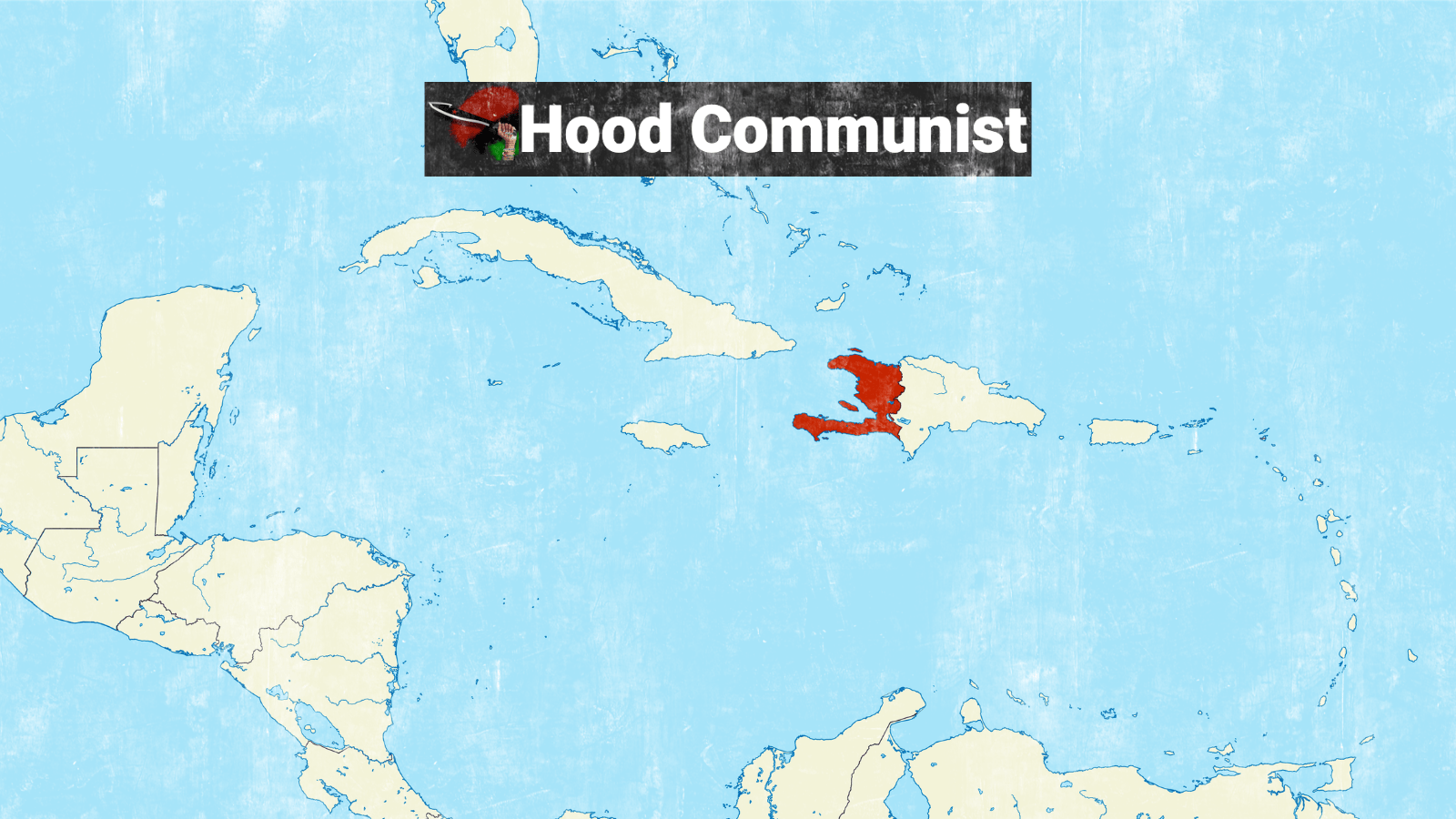
The following article by Kimberly Dawn Miller first appeared in Hood Communist on April 17, 2026.
Introduction
One of the most persistent and recycled claims in anti-communist “left” discourse is the way Black radical scholarship is selectively invoked to discredit Marxism itself. A growing class of social media influencers have cited “Black Marxists” to claim that Marxism is inherently Eurocentric, Euro-linear, and therefore incompatible with the current struggles of Africa, the Caribbean, or Asia. The Haitian Revolution is deployed as the definitive counterexample, held up as proof that Black liberation unfolded outside, and therefore against, Marxist frameworks, a Black revolution that allegedly proves Marxism’s irrelevance to the colonized Global South.
This argument collapses under even minimal historical scrutiny. Not because Marxism must be defended abstractly, but because Caribbean history already answered the question in practice. These debates are not merely academic. Today, Cuba faces intensified economic strangulation through tightened U.S. sanctions and a U.S. imposed fuel blockade, while Haiti confronts externally driven security interventions that further subordinate its national sovereignty to foreign security architectures under the primary oversight of the United States. In both cases, the Caribbean remains a terrain where imperial power constrains development and structures class formation. The persistence of these dynamics underscores the continued relevance of Caribbean Marxist analysis, not as historical interpretation, but as a framework for understanding contemporary anti-imperialist struggles in the region.
The idea that Marxism cannot be applied to the colonial world rests on a fundamental misunderstanding: it confuses capitalist development with capitalism itself. Caribbean Marxist traditions, long before algorithm-driven social media debates, explained precisely why colonial capitalism produced different class structures without ceasing to be capitalist at all.
Colonial capitalism was distorted, not absent
The claim that Africa and the Caribbean “lacked an industrial base” and therefore fall outside Marxist analysis repeats a long discredited orthodox assumption: that capitalism unfolds uniformly, following a European developmental sequence. Caribbean and African political economy thinkers rejected this decades ago.
Pivotal Global South thinkers such as C. L. R. James, Walter Rodney, Eric Williams, Lloyd Best, Norman Girvan, Frantz Fanon, Amílcar Cabral, Kwame Nkrumah, Samir Amin, and others converged on a central insight: colonial capitalism was externally oriented, extractive, and deliberately underdeveloped. Its purpose was not national accumulation, but imperial surplus transfer with longstanding legacies still felt for their regions today.
In Capitalism and Slavery (1944), historian and first Prime Minister of Trinidad and Tobago Eric Williams demonstrated that the transition from slavery to free labor did not mark capitalism’s retreat from the Caribbean, but its reorganization under new conditions of accumulation. Abolition unfolded through a sequence of linked policy shifts including the end of the British slave trade, emancipation, and the removal of sugar protections, each “inseparable” such that “the very vested interests which had been built up by the slave system now turned and destroyed that system” (Williams 1994, 109). Far from reflecting a moral awakening, humanitarian arguments for abolition gained traction only once “every important capitalist interest” ceased to depend on slavery, and plantation elites proved flexible in their principles, defending slavery or free labor alike so long as monopoly was preserved (Williams 1994, 109). What this process reveals is not the absence of capitalism, but its adaptive capacity under imperial constraint. If capitalism can operate through slavery, survive emancipation, reconfigure labor while maintaining extraction, then historical materialist analysis does not “fail” the Caribbean; it explains the Caribbean exceptionally well.
It is precisely at this juncture that the plantation economy framework developed by Caribbean political economist Lloyd Best is taken up and extended in later scholarship. Eric Williams’ historical analysis of abolition explains how capitalism reorganized itself in the Caribbean without relinquishing imperial extraction; Lloyd Best’s plantation economy framework theorizes the structural form that reorganization produced. Where Williams shows that emancipation marked a shift in the mode of exploitation rather than capitalism’s retreat in the Caribbean, Best demonstrates how the plantation economy institutionalized that shift through mercantilist trade relations, external ownership, and the systematic blocking of local accumulation (Best 1968). The post-slavery Caribbean economy was thus neither pre-capitalist nor stagnant, but structurally subordinated. It was fully integrated into global capitalism while denied the conditions for self-generated industrialization.
A detailed critique drawing on plantation economy theory challenges liberal development models that classify Caribbean agriculture as “subsistence,” unproductive, or non-capitalist (Samuda 2021, 59). What is often dismissed as “Marxist Eurocentrism” reflects the misapplication of European developmental benchmarks to colonial economies, benchmarks that Caribbean political economy thinkers explicitly rejected. Such classifications obscure the reality that agricultural and peasant sectors in economies of the Caribbean, such as Jamaica’s, were already embedded in capitalist accumulation, even as that accumulation primarily benefited British and American metropolitan capital (Samuda 2021). By the 1940s, estate agriculture had consolidated under metropolitan firms, was technologically integrated through parent companies abroad, and functioned as part of global value chains oriented toward expanding profits for external shareholders.
As Guyanese development theorist C. Y. Thomas observed, “the relationship of the metropolitan to the hinterland economy has been historically a very flexible one reflecting the domestic conditions and needs of the metropolitan area…When economically it suited Britain, for example, when she was industrializing rapidly (the free-trade era), colonial preferences were abandoned and the colonial economy suffered” (Thomas 1968, 341). Plantation economy and dependency theory analyses thus provide a realistic account of how systems of unequal development endure despite formal political change, and how mercantilist logics continue to operate through modern capitalist enterprises rather than disappearing with the end of colonial rule. Plantation economies, then, were not pre-capitalist holdovers. They were among the earliest and most violent forms of capitalist production: monocrop export systems integrated into global markets, dependent on coerced labor, racial hierarchy, and imperial trade control.
The absence of a “European-style factory proletariat” did not signal the absence of class relations, as is the refrain for anti-communist influencers. It signaled that class struggle unfolded under conditions of dependency, external domination, and distorted accumulation. This is not a deviation from Marxist analysis. It is Marxism applied dialectically.
Haiti: The case most misused and most revealing
Nowhere is this misrepresentation clearer than in how the Haitian Revolution is mobilized to argue that Marxism is incompatible with Black liberation. A recurring claim in anti-communist discourse is that Marxism is inherently Eurocentric because it presumes an industrial working class as its primary revolutionary subject. On this view, Africa and the Caribbean allegedly fall outside Marxist analysis because they “lacked an industrial base,” rendering class struggle either marginal or irrelevant.
This argument is not new. It is a repackaging of long-standing Euro-linear rigidly stageist misreadings of Marxism. The absence of a large European-style factory proletariat in the colonies does not indicate the absence of class relations; it reflects the fact that capitalist development in the colonial world was intentionally distorted by imperial plunder. This is precisely what Caribbean and Global South Marxists have wrestled with for decades.
The Haitian Revolution exposes the flaw in this argument with clarity. Saint-Domingue was not feudal. It was the most profitable colony in the world: a hyper-exploited plantation economy producing sugar and coffee for global markets, fully integrated into Atlantic capitalism and organized around large-scale labor regimes. Enslaved Africans were not peasants operating outside capitalism; they were a coerced plantation proletariat subjected to industrial-scale extraction under racial slavery.
C. L. R. James was explicit on this point. In The Black Jacobins: Toussaint L’Ouverture and the San Domingo Revolution (1938), he argues that the Haitian Revolution was the first successful revolution of a modern colonial proletariat. It did not require Enlightenment tutelage. It began before France abolished slavery. It was organized and executed by enslaved Africans, maroons, and an emerging Black officer corps operating within and against a fully capitalist system of production. Far from advancing bourgeois interests, the revolution targeted the plantation class, expelled the planter elite, and attempted to reorganize land and labor around Black mass sovereignty.
Haitian sociologist Paul C. Mocombe’s analysis builds on this insight by rejecting European teleological assumptions that treat industrialization and bourgeois transformation as universal measures of revolutionary success. Rather than denying the class character of the Haitian Revolution, Mocombe foregrounds the internal class tensions that emerged through it, particularly between the African mass base and emergent elite fractions shaped by mercantilist structures. His intervention shifts the analytical question from whether class struggle existed to how and where revolutionary rupture was constrained within the capitalist world-system.
The post-revolutionary Haitian “counter-plantation system” (Casimir 2020) was not simply a subsistence fallback or a reaction to slavery, but a class project through which the African majority refused the restoration of plantation labor and mercantilist accumulation (Mocombe 2023). As Professor and Caribbeanist scholar Tamanisha J. John says, “The Haitian revolution upset what was seen as normal social and economic relations of its day…the post-revolution environment in Haiti thus had a momentous task” (John 2024, 9:00). Factions such as the Affranchis (property-holding intermediary class of free people of color), mulatto elites, and petit-bourgeois free Blacks sought to reconstitute export agriculture through state power, the corvée system of racialized coercive surplus extraction, and control of ports and trade, “to continue the plantation-system of their former colonial slave masters,” which the mass base of the revolution rejected, advocating land autonomy, subsistence production, and selective market engagement (Mocombe 2023, 209).
In this reading, post-independence Haiti was structured by a class struggle over whether capitalist labor discipline would be restored or fundamentally rejected. Jean-Jacques Dessalines, Haiti’s first head of state, attempted to balance elite demands for state-led export accumulation with mass demands for land, autonomy, and non-plantation labor, representing an early experiment in agrarian socialism.
Crucially, the emergence of a peasantry in post-revolutionary Haiti does not invalidate the Haitian Revolution’s revolutionary capacity, as some Eurocentric critics often imply. That peasantry did not precede capitalism as a pre-modern remnant; it emerged through revolutionary rupture, as plantations collapsed and land was seized. In Marxist terms, this represents a transformation of class structure under conditions of liberation, not evidence that class struggle was absent or irrelevant.
These contradictions are not confined to the nineteenth century. Haiti continues to confront externally mediated attempts to reorder its social and economic relations. The current foreign-backed Gang Suppression Force, an extension of the prior Kenya-led, U.S. sponsored Multinational Security Support Mission propped up by unelected governments, reinforces elite and paramilitary control over Haiti’s ports, trade, and urban space, while marginalizing popular sovereignty and resistance. In this sense, Haiti once again becomes a site where imperial security doctrine and foreign intervention intersect with class struggle over land, labor, and political authority. The historical struggle between export-oriented elites and popular autonomy is ongoing.
Caribbean Marxism and the “Eurocentrism” question: Cuba and Grenadian revolutionary practice
If the Haitian Revolution deeply complements Marxist analysis of the colonial world, the Cuban and Grenadian Revolution resolve the question of regional applicability in modern revolutionary practice. Cuba confronted a racially stratified, export-dependent economy dominated by U.S. capital and land concentration. Marxism was not an imported European blueprint, but a tool used to dismantle that dependency, redistribute land, expand literacy, consolidate sovereignty, and exert revolutionary internationalism under ongoing imperial pressure.
The New Jewel Movement in Grenada confronted a familiar set of constraints: limited industrial proletariat, a large informal and rural population, and overwhelming dependence on external capital. Yet rather than rendering Marxist analysis irrelevant, these conditions shaped its application. Land reform, mass political education, women’s participation, and popular councils were not deviations from Marxism but expressions of it under post and neocolonial constraint. It adapted to the material realities of a small, majority Black, postcolonial island society.
This historical record is significant in light of debates over Marxism’s alleged Eurocentrism. In a January 2026 iMixWhatiLike episode hosted by Professor Jared Ball, Marxist political scientist August Nimtz explicitly frames his critique of Cedric Robinson’s Black Marxism: The Making of the Black Radical Tradition (1983) through the historical conjuncture that produced it, namely, the late-1960s debates within Black liberation circles over “the relative weight of race vs class” and, more fundamentally, “whether or not a Marxism perspective was relevant at all to making sense of the Black struggle” (Nimtz 2026, 4:03). Nimtz situates his critique as emerging directly from political-historical work in the archives: “as I was going through the archives…on my work on African liberation support committee…from 1968–69 there was an intense debate within the Black struggle” (Nimtz 2026, 3:45-4:00).
On that basis, he concludes that Robinson, “despite the title of his book Black Marxism…was really a cultural nationalist defense of the Black struggle” (Nimtz 2026, 4:16). But Nimtz argues that the historical problem became sharper by 1985 precisely because the Caribbean had already answered the question in practice. As he puts it, when the book came out in 1983 it was “in a context of developments in the Caribbean especially Grenada revolution beginning in 1979,” coupled with the Cuban Revolution decades prior. For Nimtz, these were not symbolic reference points but concrete revolutionary evidence that “it was no longer a sterile academic debate but facts on the ground,” and those “facts on the ground…required we rethink the Black struggle from a cultural nationalist perspective” (Nimtz 2026, 6:20).
In other words, Grenada demonstrates Caribbean Marxism not as interpretive, but as revolutionary praxis where class struggle, state power, anti-imperialist rupture, and mass political education become the terrain through which Black liberation is materially advanced. For revolutionary organizers in the Caribbean, what mattered was not whether Marxism emerged in Europe, but whether it could be wielded to dismantle neocolonialism and class domination in the Global South. Marxism was not antithetical to Black struggle because it addressed the material structures of exploitation shaping Caribbean life.
That the Grenadian revolution was violently crushed by U.S. invasion, ushering in mass illiteracy, regression of women from public and educational life, and “neocolonial takeover,” does not negate its significance (John 2024, 49, 36). Professor John also emphasizes that the question of a revolutionary line in Grenada was not simply theoretical. Internal divisions emerged between cadres committed to a more orthodox scientific socialist approach and those who argued for a revolutionary trajectory more organically led by the masses. John’s comparison to the Haitian Revolution is instructive: internal splits over political direction, popular legitimacy, and a strategic vision can become vulnerabilities that external enemies actively exploit. “When we upset social and economic relations you have to create new ones,” whether “these new ones are scientifically informed in one way” or acknowledge that “how social and economic relations are built and rebuilt and reconstituted should be led by the masses” (John 2024, 50, 41).
Rather than disproving Marxism’s relevance to the Caribbean, however, Grenada illustrates that Marxist revolutionary praxis was sufficiently impactful to trigger imperial panic, and that the greatest threats to socialist projects in the Western hemisphere combine external coercion with intensified internal contradiction. Long before Black Marxism was published, Caribbean Marxists were already analyzing race, class, and empire as mutually constitutive within global capitalism. They did not need to abandon Marxism to do this; they extended it.
Moreover, the durability of Cuba’s revolution under renewed economic siege, with over sixty-seven years of U.S. embargo, further illustrates this dynamic. Intensified sanctions, fuel blockade, militarist threats from the U.S. empire, and efforts to isolate Cuba economically represent current forms of imperial coercion designed to reverse its sovereign development. That Cuba continues to reproduce social life under these constraints reflects not mere resilience, but the institutional foundations of a socialist project organized around public provision, planned distribution, and sovereign social reproduction outside market dependency. It underscores the enduring relevance of Marxist analysis in the Caribbean, where sovereignty, class formation, and imperial pressure remain inseparable.
Caribbean dependency theorists demonstrated that colonial capitalism blocked industrialization precisely because it relied on racialized labor and export monoculture. This distortion did not negate class struggle; it reshaped it. Plantation workers, dockworkers, informal laborers, landless peasants, and comprador elites all emerged as class actors within a global system structured by imperial hierarchy. Thus, the Caribbean was not outside Marxism, but central to refining it. From the Haitian Revolution to Grenada’s confrontation with imperial intervention, to revolutionary Cuba’s endurance under a blockade, the region reveals how class struggle unfolds under conditions of capitalist racism, dependency, and external coercion. Today’s sanctions, foreign-backed security missions, and economic strangulation show that these contradictions remain unresolved. Caribbean Marxism therefore endures as a material analysis forged in struggle, one that continues to illuminate how imperialism shapes sovereignty, class formation, and revolutionary possibility in the modern world.
References
Best, Lloyd. (1968). “Outlines of a Model of Pure Plantation Economy.” Social and Economic Studies, 17(3): 283-323.
Casimir, Jean. (2020). The Haitians: A Decolonial History. University of North Carolina Press.
James, C.L.R. (1989). The Black Jacobins: Toussaint L’Ouverture and the San Domingo Revolution. Vintage Books.
Mocombe, Paul C. (2023). “The Haitian Revolution and Jean-Jacques Dessalines: The End of History and the Last Man Standing.” Philosophy Study, 13(5): 204-213.
Samuda, Paula-Leone. (2021). “Plantation Economy Model as Developed by Lloyd Best and Kari Polanyi Levitt: The Case of Jamaica.” Electronic Theses and Dissertations.
Thomas, C. Y. (1968). “A Model of Pure Plantation Economy: Comment.” Social and Economic Studies, 17(3): 339-348.
Williams, Eric (1994). Capitalism and Slavery. University of North Carolina Press.
John, Tamanisha. (2024, April 2). “Haiti, Cuba and Grenada: Three Caribbean Revolutions with Tamanisha John.” Millennials Are Killing Capitalism, available here.
Nimtz, August. (2026, January 6). “Why Black Marxism Discourages Marxism.” iMixWhatiLike, available here.
About the author
Kimberly Dawn Miller is an environmental sociologist and postdoctoral researcher whose work examines Caribbean sovereignty, ecotourism, and climate resilience under imperial constraint, with focus on Afro-Indigenous cultural revival and neocolonial development in the Lesser Antilles. She is a member of the Black Alliance For Peace and co-coordinator of the Haiti/Americas Team.