

Editor’s note: This article was first published by Monthly Review on October 02, 2026.
Emblematic of Palestinian art, the painter Sliman Mansour died in Jerusalem on Monday, August 24, leaving the world a precious legacy: an art whose symbolism mourns the longest exile of our age.
The art of resilience
As relentless bombardments erase what remains of a people and its history, the death of Sliman Mansour resounds like a plea. Considered the pioneer of Palestinian art, Mansour devoted his life to resisting the occupation through the force of his brush. Born in 1947 in Birzeit, in what is now the occupied West Bank, he studied fine arts in Jerusalem and persisted in living there, despite constant harassment by Israeli soldiers at the checkpoints separating him from his studio in Ramallah, as well as repeated violence and imprisonment at the hands of the Israeli authorities, who objected to the political charge of his work.
Exile, woven into the flesh
For Mansour, painting became a vessel for memory. In many of his canvases, he nurtured the memory of a golden age, when Jerusalem and its labyrinthine little houses slept in immaculate serenity. Bucolic mazes, often crowned by the golden shades of the Dome of the Rock, that, beyond their emotional pull, seek to correct the colonial narrative—the one that would have us believe that, before Israel, there was nothing.
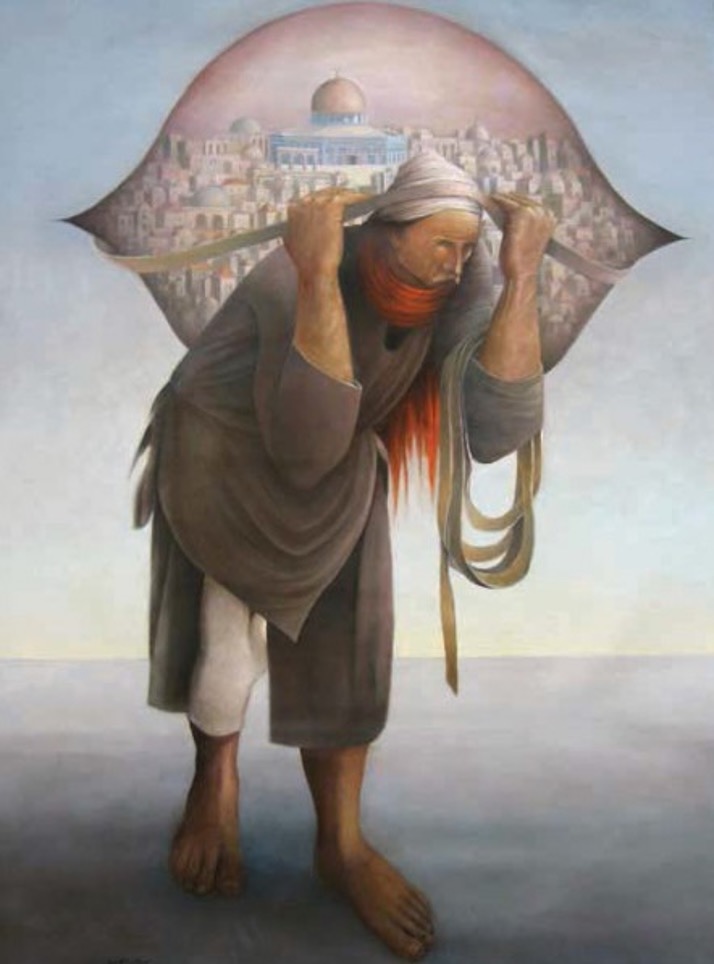
His iconic Camel of Hardships, considered the most famous painting by a Middle Eastern artist, depicts a man in exile buckling beneath the weight of memory, a memory taking the shape of an eye, as if forcing us to see the invisible: nostalgia carried as life sentence. “It is also the weight of the emotional burden,” he shared with us in 2024. “I am not myself a refugee, but when I go to Jaffa, Acre, Haifa or Galilee, I feel the loss and the consequences of the Nakba—the forced exodus that Palestinians endured in 1948; a feeling made all the more tangible when I observe the way they are treated as foreigners or second-class citizens.” A chronic exile at home.
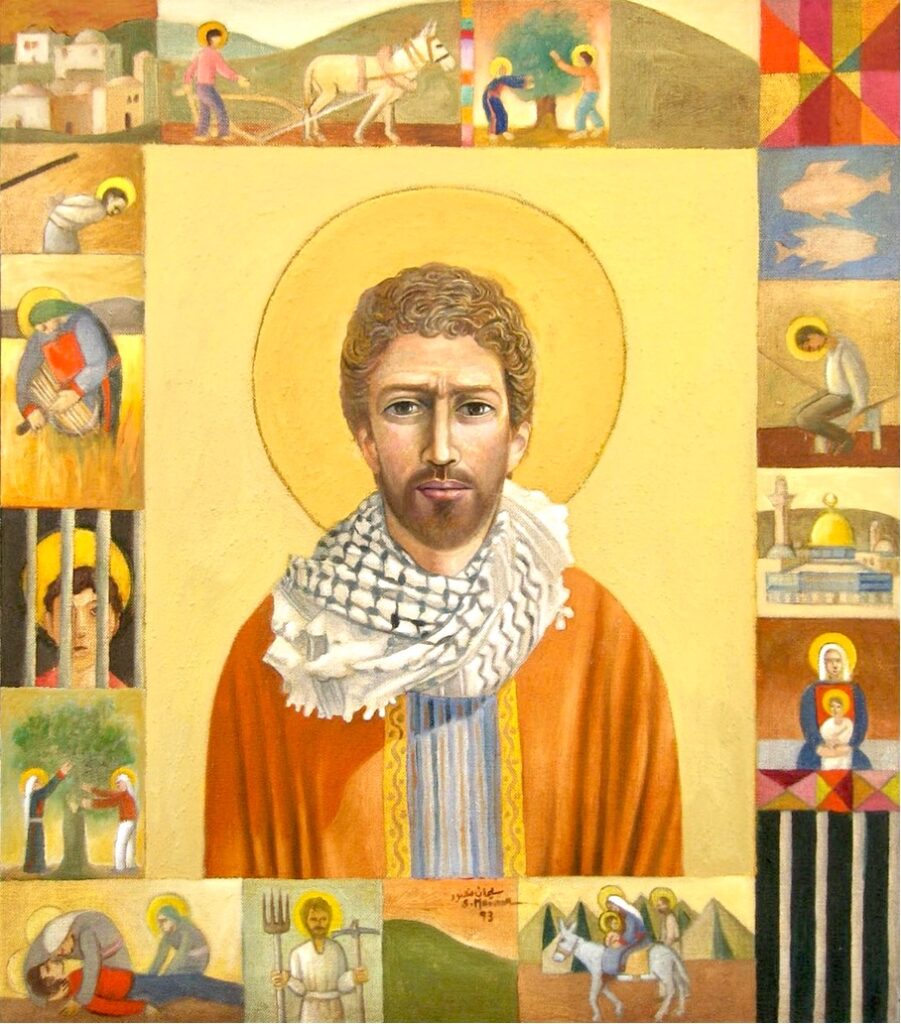
This everyday violence is denounced with great subtlety in works such as The Nazarene and The Way to Bethlehem, in which Mansour crowns his figures with halos, evoking a sacred grace intrinsic to this region—the cradle of the three great monotheistic faiths of our history, and one that the military agenda seems to profane day after day.
Between thwarted destinies and walled-in cultures
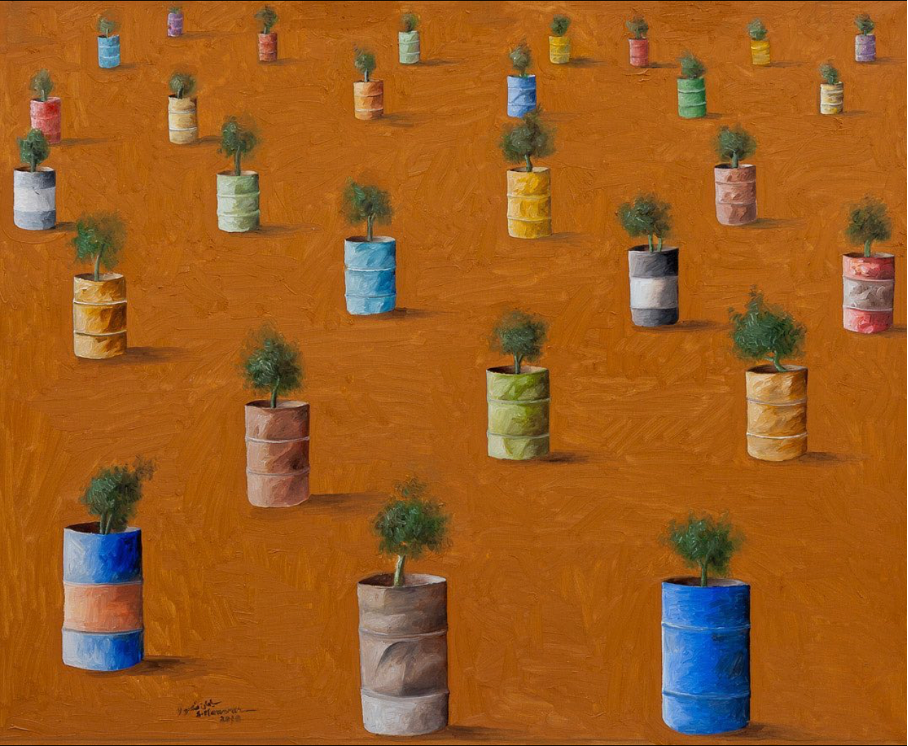
Running like a thread through this nostalgic plea are recurring symbols of Palestine which, beneath their romantic appearance, pulse with political commitment: citrus fruits, vestiges of a time when the land was abundant and still belonged to everyone; the watermelon, transformed into an abstracted emblem of a censored flag; the dove, a promise of freedom; and above all, the olive tree, which, beyond its symbolism of peace, has throughout his work given tangible form to the suffocated realities of deportation, apartheid, and ethnic cleansing.
In his painting New Start, for instance, each tree, uprooted, seems forced to learn to grow anew in an artificial environment, as though deprived of access to its nearby red, fertile soil by a separation that makes no sense: a way of denouncing the inhumanity of the separation wall and the wrenching carving-up of the land—a process the Israeli historian Ilan Pappé has denounced throughout his writings as a deliberate political strategy of weakening, aimed at the dispersion of what remains of the Palestinian people across disconnected enclaves, so as to prevent them from forming a common body of resistance against an ever-expanding occupation. The planned disunion of a people.
Through the olive tree, Mansour thus depicts physical and geographical isolation, but also the inexorable risk of acculturation it entails; a form of moral and psychological exile, of imposed social sterility, aimed at the extinction of a culture.
Woman, the revolution’s last guardian
In Mansour’s work, women take center stage. Under his brush, they stand as a personification of a collective identity and its perpetuation, as the artist explained in our 2024 exchanges: “In my work, woman is a symbol of the homeland, and therefore of the revolution. She represents the Palestinian identity in its collective dimension, in all its strength, pride and beauty.” As the original source of this intergenerational creative energy, woman emerges as a refuge, carrying with her across the world the seal of a memory in which mother and land become one.
His painting The Immigrant pushed this interpretation to its peak: a woman stands carrying oranges, dressed in traditional Palestinian embroidery against an ultramodern backdrop. Amid steel skyscrapers and yellow cabs, her gaze stands as a defiance against any further dispossession. The staging inevitably recalls Nickolas Muray’s famous 1946 photograph of Frida Kahlo on her New York rooftop, where the unapologetic embrace of garb so radically out of context seems to rise into a revolutionary hymn.
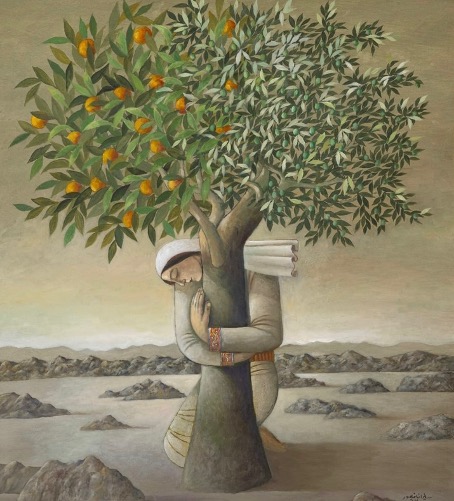
Colors that carry life. And yet, not so long ago, he confessed to us that in his latest paintings, created during the recent events in Gaza, he had surrendered to duller colors, rendering his landscapes hazier, almost monochromatic. Perhaps a way of quietly admitting, beneath the activism, a despairing sorrow in the face of the intensifying genocide that would mark the final chapter of his life. A feeling he would speak of only in whispers, choosing instead, until the very end and against all odds, to instill in those who need it the courage to hope.
Featured photo: Sliman Mansour, The Way to Bethlehem, 2022 (left) and Jerusalem in the Heart, 1979 (right). Credit: Silman Mansour, Monthly Review.