

Introduction: Understanding to transform
To challenge and transform a system, we must first understand how it operates–not just in general but in the specifics: where power is concentrated, whose interests certain structures serve, etc. The analysis provided in this and following articles is intended as a tool for political education—one that strengthens our collective understanding of Indianapolis’ history, sharpens our analysis of the present, and helps guide our organizing efforts moving forward.
The lessons contained within this series of articles are laid out to raise and deepen our own consciousness, expand the political understanding of our class and our communities, and build the knowledge necessary to organize for meaningful transformation in Indianapolis. Unigov is a concrete example of the contradictions of capitalism as it plays out in our city.
What exactly is Unigov?
“Unigov,” which is short for “united government,” refers to the city–county government enacted by the Indiana General Assembly that consolidated parts of Indianapolis and Marion County. In 1970, at the time of the merger, Indianapolis was only one of several municipalities within Marion County. The Unigov legislation excluded any incorporated city other than Indianapolis and any incorporated town with more than 5,000 residents. This exempted the cities of Beech Grove and Lawrence, along with the town of Speedway. Southport secured the same status by incorporating as a city just before Unigov took effect on January 1, 1970.
These four municipalities, or “excluded cities,” remain part of Marion County but not the consolidated City of Indianapolis. They retain their own municipal governments and continue providing many local services while remaining subject to countywide ordinances, taxes, and services. Because they contribute to county government, their residents also vote for the mayor of Indianapolis and members of the City-County Council, in addition to electing their own local officials. The legislation also created a separate category of “included towns,” extending limited autonomy to sixteen municipalities: Castleton, Clermont, Crows Nest, Cumberland, High Woods, Homecroft, Lynhurst, Meridian Hills, North Crow’s Nest, Ravenswood, Rocky Ripple, Shore Acres, Spring Hill, Warren Park, Williams Creek, and Wynnedale. Although these communities remained legally part of Indianapolis, most initially opposed their inclusion in Unigov.
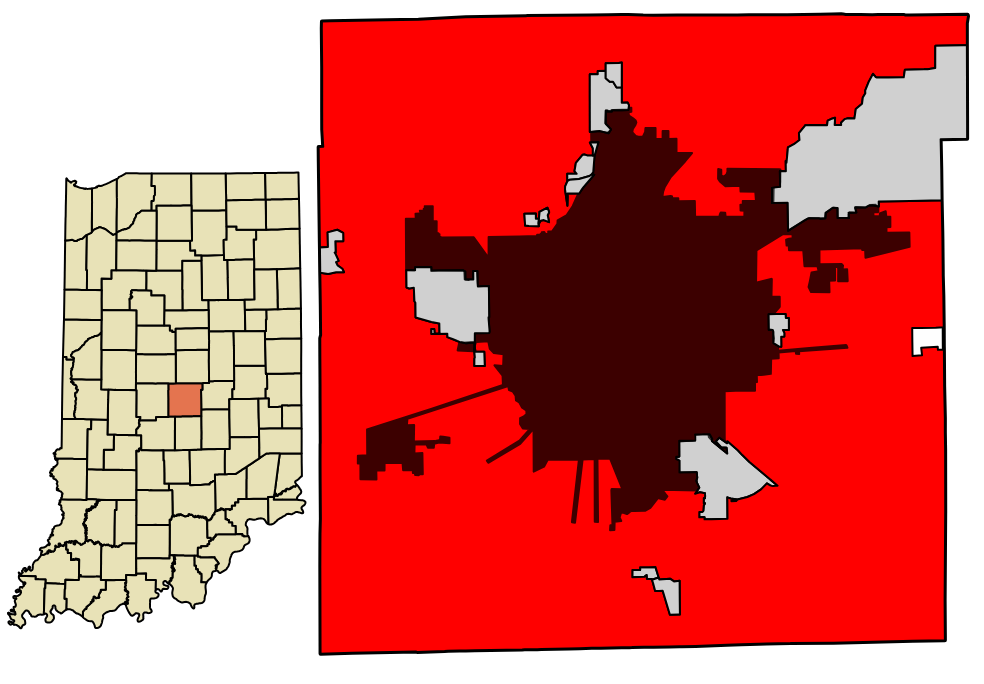
Pre-Unigov Boundries on top of Post-Unigov Boundaries. Credit: IndianapolisWikipedian.
Under Indiana Code 36-3-1-4(a)(2), included towns retain their legal identity and limited self-governing authority. Unlike the excluded cities, however, they are fully incorporated into the consolidated City of Indianapolis and remain subject to the authority of the Indianapolis municipal government.
Supporters of Unigov justified these distinctions as administrative necessities such as reporting the “balance” for the U.S. Census Bureau. In practice, however, the municipalities granted excluded status were among Marion County’s wealthier, politically influential suburban communities and had mounted some of the strongest opposition to consolidation. Exempting them from full incorporation reduced resistance to Unigov while preserving their local political power and autonomy.
Unigov and the fight between two factions of the capitalist class
Unigov was presented as a way to streamline and make local government more efficient but it was a way to solidify and prop up the Mayor of Indianapolis and consolidate and expand his control. This is a bipartisan effort. While Dick Lugar was a Republican, Unigov proved to be fruitful for multiple decades and both mainstream capitalist parties. The bipartisan benefits of Unigov are best explained when we place it in context of the Demonstration Cities Act of 1966—a response to President Lyndon B. Johnson’s “War on Poverty”—and the contradictions at play between both capitalist responses to the rising tide of social movements.
With the official poverty rate standing at nearly 20 percent, in his 1964 State of the Union Address Johnson announced his administration’s plans to, among other things, expand Social Security, Medicare, Medicaid, food stamps, economic and employment opportunities, job training, and other elements of what we could call the most rudimentary social programs. Johnson wasn’t motivated by the poverty rate so much as he was by the increasingly militant Black liberation movement. Johnson’s announcement came a year after four major urban rebellions—in Birmingham, Baltimore, Cambridge, and Washington, D.C. Across the South, there were nearly 1,000 anti-racist demonstrations in over 100 cities.
While this outraged conservatives it did little to placate the Black and oppressed masses. Martin Luther King Jr., who earlier called Johnson’s plans “too piecemeal,” connected the War on Vietnam to the War on Poverty three years later in his famous speech, “A time to break the silence” at Riverside Church in New York City. In his speech, Dr. King said the War on Poverty included “hopes, new beginnings” but “then came the buildup in Vietnam… and I knew that America would never invest the necessary funds or energies” in genuine social programs while it carried out imperialist aggression abroad. Even more fundamentally, Johnson’s premise rested on his belief that one could “cure” poverty and economic inequality under the capitalist system—a system that necessitates such inequality.
In effect, then, Unigov was part of a reaction by one faction of the capitalist class to another faction that wanted to put a “nice face” on capitalism and racism.
In the next installment in this series, we’ll look at the complicated history behind the design and implementation of Unigov before detailing the long shadow it continues to cast over our city.
Featured image: President Lyndon B. Johnson meeting with Martin Luther King, Jr. in March 1966. Source: Public Domain.