
As the U.S. celebrates 250 in existence after 13 colonies declared their independence from Britain with the Declaration of Independence, we invite all to gather and revisit Fredrick Douglass’ enduring speech, “What to the slave is the Fourth of July?” Delivered on July 5, 1852 to the Rochester Ladies’ Anti-Slavery Society, his speech poignantly highlights the dishonesty and deception of celebrating “independence” during a time in which millions of Black people were subjected to human trafficking and the worst kinds of routine torture and abuse.
His audience was an abolitionist group sponsored by Britain that lent financial support to Douglass and others as part of the fight for the immediate abolition of chattel slavery. The speech is as brilliant and incisive as it is relevant to our era today. That Douglass addressed women as “fellow-citizens,” which neither Douglass nor the audience were recognized as under the law, shows his forward and bold-thinking and refusal to wait for the oppressor to grant the oppressed citizenship.
Through a collective reading and shared discussion, we will grapple with Douglass’ words not as historical artifacts, but as living questions: Where have we been as a people, and how do we chart the road ahead? And more urgently, how do we, as a people, truly liberate ourselves from systems of oppression that persist in new forms? For example, we all know that the 13th Amendment abolished slavery… except in prisons. The 14th amendment, particularly the “Equal Protection Clause,” was allegedly meant to protect the rights of Black people. Yet even the Supreme Court noted 50 years after its passing that the majority of cases it heard that invoked the 14th Amendment concerned the rights of corporations.
Here in Indiana, the Department of Corrections tells us it will keep Indiana State Prison, where numerous inmates have been burned alive, open after promising its closure. The DOC is finishing constructing a new $1.2 billion prison in Westville, Indiana they initially said would replace ISP. They recently confirmed they designed the new prison to allow for state murders by both lethal injection and firing squads (even though the latter aren’t legally allowed yet).
Similarly, as Shaka A. Shakur has written about—and been subjected to—while the Fugitive Slave Act was formally repealed by Congress in 1864, enslaved New Afrikans and other Political Prisoners continue to be trafficked across state lines without any due process, advanced knowledge, nor rights to appeal. What is called the Interstate Corrections Compact is a modern-day version of the Fugitive Slave Act.
Douglass’ words and Shaka’s story call us to more than remember. They demand that we listen, learn, and become active participants in the unfinished work of justice. We hope you will join us on July 4th to read, reflect, and imagine together what true liberation might look like—and how we might begin to build it. And we hope you join us to win true liberation.
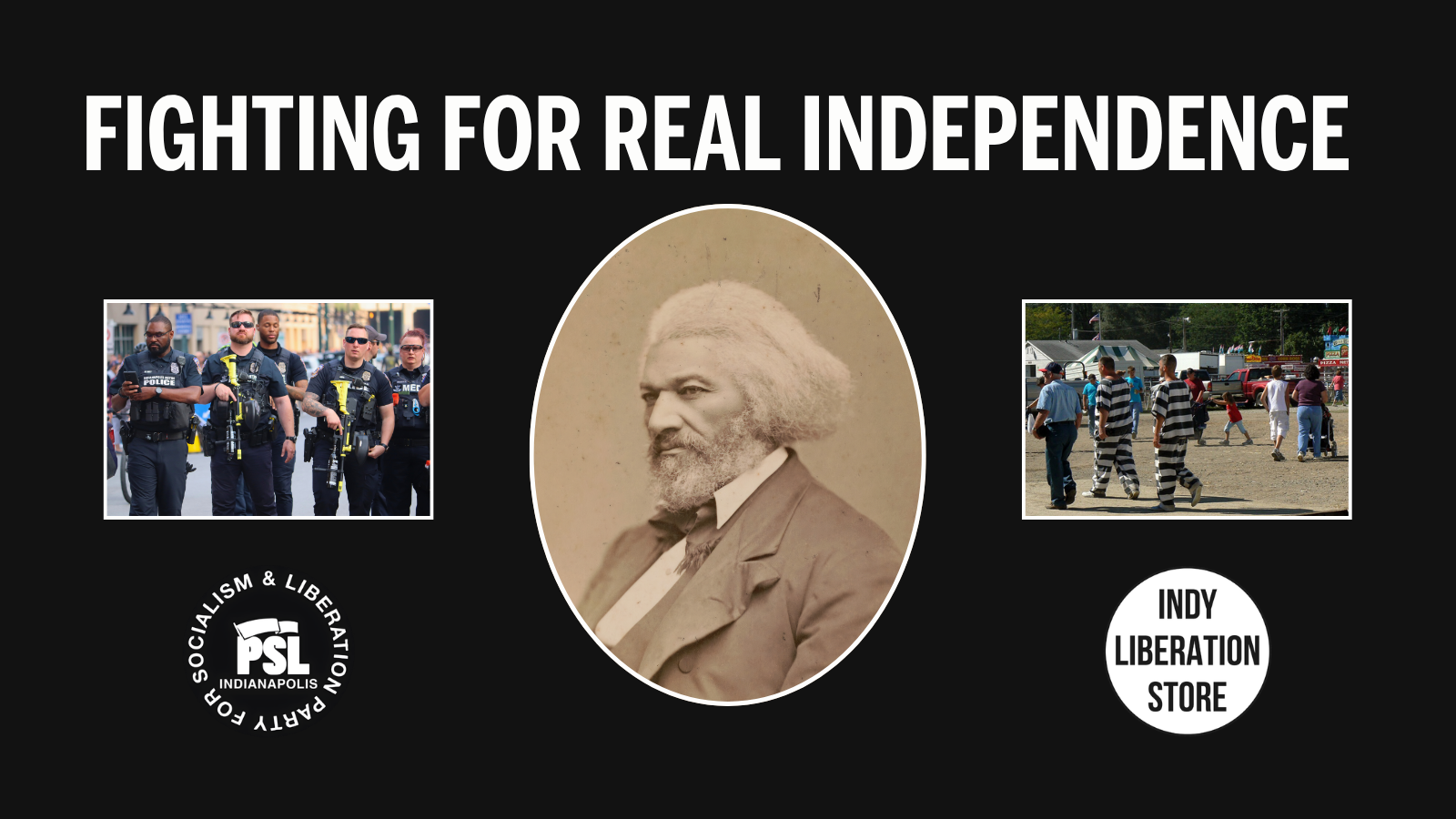
Featured image: Portrait of Frederick Douglass surrounded by IMPD officers in 2025 on the left and a chain gang cleaning up trash at a fair in Ohio in 2007. Credits: Public Domain, Indianapolis Liberation Center, and Benny Mazur.